
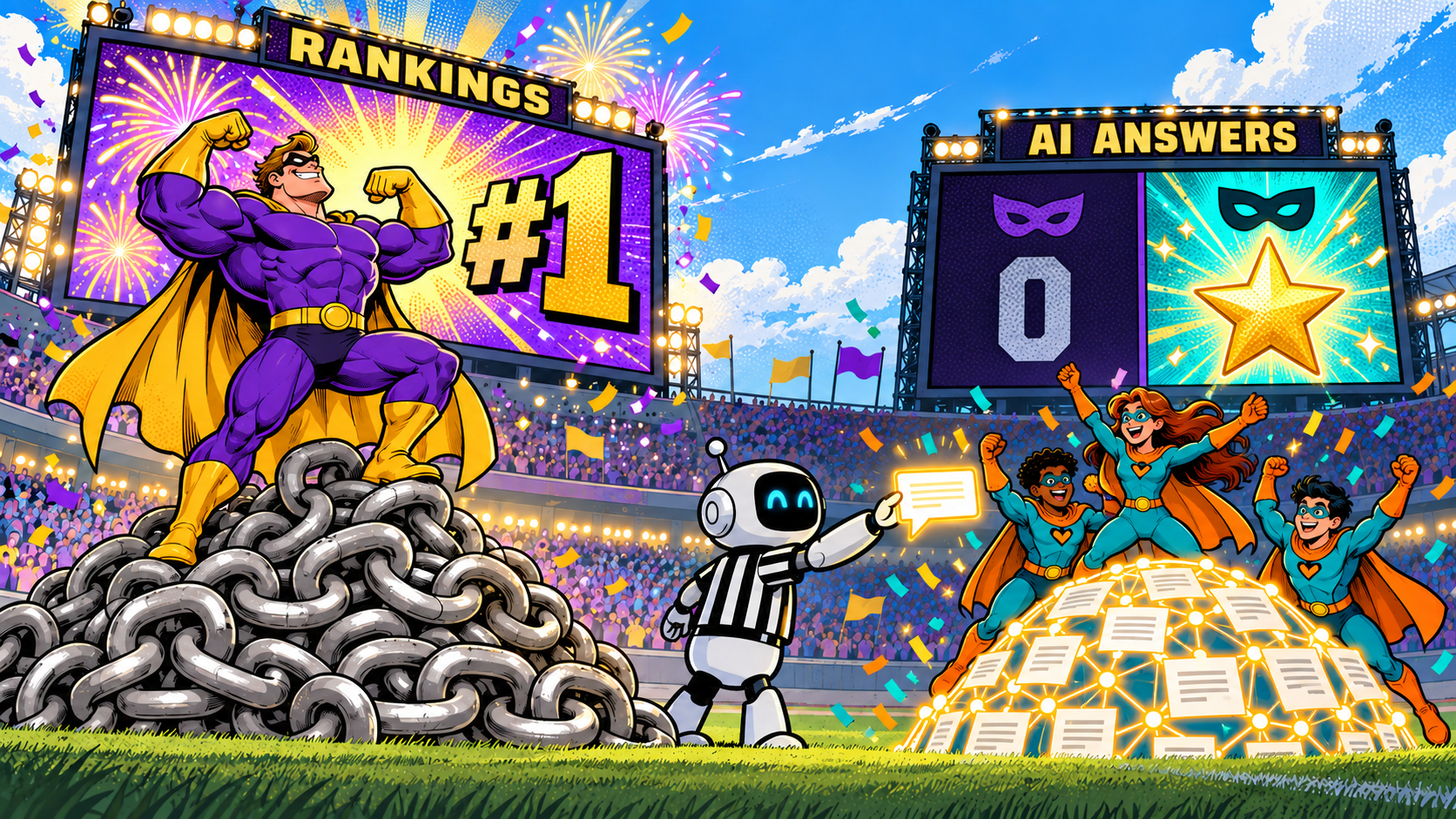

Belief 1 of 7 from the VizzEx AI Citation Study mid-study findings
One website in our study has 96,000 other websites linking to it. It is one of the best-known marketing publishers on the web.
ChatGPT has never cited it. Not once, at any checkpoint in the study.
That site is one of our control group, and it is the reason Belief 1 was the first row on our scoreboard.
The Belief: Strong SEO Carries Over Into AI Visibility
“Strong SEO carries over into AI visibility.”
This is the continuity camp’s position. AI citation is downstream of good SEO, so you don’t need a separate practice: rank well and the AI answers will follow. The LinkedIn post that said so most clearly drew 535 reactions. It’s a comfortable belief. It means the budget you already spend is the budget you need, and the team you already have is the team you need.
We didn’t have to guess whether it was true. We had a control group that is this belief, maxed out.
How we tested it
The VizzEx AI Citation Study is a controlled, 84-day experiment on live websites:
| Sites | 10 live websites across six industries |
|---|---|
| Treated sites | 8, running the VizzEx methodology |
| Control group | 2 famous marketing publishers, left untouched |
| Questions | ~1,200 real buyer questions, drawn from the sites’ own content |
| AI platforms | Google AI Overviews, ChatGPT, Claude, Perplexity |
| Schedule | Fixed weekly checkpoints since July 25, with every raw answer stored |
One of the ten sites is ours, vizzex.ai.
We don’t ask “did the site show up?” We record four different things, because they are four different outcomes:
Four words that get confused in every AI-visibility conversation
- Cited
- Your page is among the answer’s sources (the footnotes or source panel), whether or not the answer says who you are.
- Named
- The answer’s own text says your company’s name.
- Recommended
- Both at once. You’re cited and named.
- Absorbed
- Your idea is in the answer, sometimes nearly word for word, with no link and no name.
Most AI-visibility dashboards count the first one and call it visibility. We count all four, per question, per platform, per checkpoint.
The Control Group: 96,000 Backlinks, Zero AI Citations
If SEO carried over into AI visibility, these two sites would own AI search.
| Famous marketing publisher A | Famous marketing publisher B | |
|---|---|---|
| Other websites linking in | 96,060 | 4,367 |
| Domain rank (0–100 scale) | 79 | 47 |
For comparison, one of our client sites has 408 referring domains, and that number has been falling all year.
Two Scoreboards: SEO Authority vs. AI Citation Results
Here is what happened when we checked the AI answers to the same questions, week after week.
| What we measured | The two famous publishers | The treated sites |
|---|---|---|
| Structural win rate against the pages currently holding the answers | 12–13% | 76–94% |
| ChatGPT citations: questions cited at the last checkpoint before the webinar | 0 of 50 | 55 of 1,149 |
| Named in the answer: prose namings in generic-topic citations | 0 of 41 | 26 of 398 |
ChatGPT without our own site: 30 of 934.
Here’s what’s behind those rows.
Structural Win Rate: Why Authority Didn’t Build Citable Pages
For each question, we put the publisher’s page head to head against the page that currently holds the answer, and score both on the same structural audit. The audit measures VizzEx Semantic Geometry: whether a page’s headings, sections and content density let an AI system cut it into clean, citable pieces. It also runs the VizzEx Symmetry Gate™, a pass/fail check that the raw HTML, the rendered page and the schema markup all say the same thing.
The famous publishers win 12 to 13 percent of those matchups. The treated sites win 76 to 94 percent. Decades of authority did not produce pages that are easy for an engine to read and trust. (The full specifications: the VizzEx Semantic Geometry Standard and the VizzEx Symmetry Gate Protocol.)
ChatGPT: zero. Both sites, every checkpoint. It isn’t a crawling problem. When we checked ChatGPT’s own cache, the 96,000-link publisher’s pages were there, some crawled within the previous two weeks. ChatGPT has the pages. It doesn’t choose them.
The renovation. One of the publishers completed a six-week professional schema renovation while the study was running. It was a real, well-resourced effort. Their structural win rate went from 13.9% to 13.5%. It bought nothing.
“But what about Google’s AI Overviews?”
This is the fair question, because Google’s AI Overviews are built on Google’s own index, where these two sites are strongest.
So we gave them the easiest test possible. We registered the control sites only on questions where they were already being cited in AI Overviews when the study began. They didn’t have to win anything new. They just had to hold what they had.
We gave the treated sites the same test: the questions each one was already cited on in AI Overviews at the start, followed to the last checkpoint before the webinar.
| Site | Cited in AI Overviews at the start | Still cited at the end | Held at every checkpoint | Total cited at the end |
|---|---|---|---|---|
| Publisher A (96,060 links) | 5 | 2 of 5 | 2 of 5 | 6 |
| Publisher B (4,367 links) | 15 | 8 of 15 | 5 of 15 | 9 |
| Two publishers combined | 20 | 10 of 20 (50%) | 7 of 20 (35%) | 15 |
| Eight treated sites combined | 86 | 59 of 86 (69%) | 37 of 86 (43%) | 80 |
Even on Google, even on their own ground, SEO dominance held roughly a third of the answers it used to own. Publisher A’s AI Overview positions came and went from checkpoint to checkpoint. Publisher B’s slid, with no recoveries.
Given the same test, the treated sites kept 69% of their starting positions to the publishers’ 50%, and 43% held at every checkpoint to the publishers’ 35%. Google is where SEO and AI search overlap most, and even here the gap shows.
Perplexity: Cited Constantly, Named Never
And Perplexity? Perplexity cites them constantly. It has never once said either name. Across the AI answers in the study, the two publishers have been cited 41 times and named zero times. They are footnotes under someone else’s answer. The gap between those two outcomes—cited vs. recommended in AI answers—turns on the question being asked, and it’s a distinction that changes how you measure success entirely.
Ranking gets you in the room. It doesn’t get you a seat.
SEO isn’t worthless for AI visibility, and the data says where it does carry over. On Google’s AI Overviews, ranking matters:
| AI Overview citations where the cited page also ranks top 10 for the question | 82% |
|---|---|
| AI Overview citations where the cited page does not rank top 10 | 18% |
| Top-10 rankings (with an AI Overview on the page) that are cited in it | 72% |
| Top-10 rankings (with an AI Overview on the page) that are not cited in it | 28% |
So on Google, ranking is close to a ticket in the door, but more than a quarter of top-10 pages are passed over for the answer.
Where SEO Does and Doesn’t Transfer to AI Visibility
The other engines are harder still:
- ChatGPT ignored both of the best-ranked sites in our study at every checkpoint.
- Perplexity cites them and never says who they are.
Ranking gets you into the room. It doesn’t get you a seat, and it doesn’t get your name said.
The Third Scoreboard: Your Dashboard May Be Showing a False Win
Here’s the part that should bother anyone paying for SEO-borne AI-visibility reporting: dashboards built with the same mindset as rank tracking, probing the same seed-keyword phrases. Most of your ideal customers don’t type those phrases into AI search, whichever platform they use. Do you?
Over the same weeks, both famous publishers’ index footprints grew by 12% and 16%. Hundreds of new keyword-level entries appeared in the data that most visibility dashboards are built on. A dashboard built on that data would have shown both sites climbing.
Meanwhile:
- their ChatGPT citations stayed at zero;
- their names never appeared in an answer;
- their AI Overview positions on the questions they started with held steady at best, and at worst fell by nearly half.
Two scoreboards. Winning one doesn’t post a score on the other. And the third scoreboard, the one most teams are looking at, can tell you you’re winning while you lose.
Two kinds of links
SEO has always been about links, and links did matter in this study. Just not the ones SEO counts.
There are two kinds, and in this study they point in opposite directions:
- Links from other websites into yours are authority. That’s what SEO builds. One famous publisher has 96,060 of them, and zero ChatGPT citations.
- Links inside your own site, between your own posts, are structure. That’s where the treated sites differ. It matters because of what gets cited: 92% of the citations on buyer questions in this study went to blog posts, not to the sites’ other pages.
Not every internal link counts. A semantic relationship link says, in a full sentence, how two posts relate and why the reader should follow it. A keyword link just makes a word clickable. Our free quick course, What are Semantic Relationships and Why do they Matter?, walks through what they are and how to write them.
What those links do to whether a citation holds is Belief 5 in this series, with the before-and-after numbers.
Verdict: SEO Wins the Ranking, Not the AI Answer
SEO wins the ranking. It doesn’t win the answer.
The belief fails for a simple reason: an AI engine isn’t ranking a keyword. It’s answering a question, and it picks the source it can read, confirm and trust for that question.
On every measure we have, the treated sites’ pages do better than the two most SEO-dominant sites in the study, even though those sites have many times more links:
- their structure wins the head-to-head matchups;
- they answer the specific questions buyers actually ask;
- their posts are linked to one another by meaning, not by keyword.
Three Steps to Audit Your AI Visibility Today
1. Look at what your AI-visibility dashboard is actually asking. Open it and read the prompts it tracks. If they’re keyword-shaped (“marketing automation,” “best CRM tools”), it’s grading you from an SEO mindset. That’s not the conversation your buyers are having with AI engines. Buyers ask whole questions about their own situation, and that’s where the treated sites in our study win.
2. Separate “cited” from “named.” If your reporting counts a link in the sources and calls it visibility, you can’t tell a footnote from a recommendation. The famous publishers in our study have plenty of footnotes and zero recommendations.
3. Stop assuming your SEO wins transfer. Check your best-ranking pages in ChatGPT, Claude and Perplexity on the actual questions they answer. Some will be cited. Many won’t. The gap between those two lists is your AI-visibility work.
What’s Next: The Other Six Beliefs in the VizzEx AI Citation Study
Belief 1 is the first of seven things everyone says about AI search that we put on a scoreboard. The rest of this series covers the other six:
- being cited vs being recommended;
- whether schema markup is the fix;
- whether authority is the price of admission;
- whether citation volatility is random;
- whether head terms are the prize;
- whether more content is the answer.
The study ends October 17. At the end we’ll re-score every row on the board against the final data, including the predictions we filed at mid-study, whichever way they go.
Kim Albee is co-founder of VizzEx with Carolyn Holzman. The VizzEx AI Citation Study is a controlled, 84-day study of how Google AI Overviews, ChatGPT, Claude and Perplexity choose, keep and name their sources.
Frequently Asked Questions
Does strong SEO automatically lead to visibility in AI search results?
One website in our study has 96,000 other websites linking to it. It is one of the best-known marketing publishers on the web. ChatGPT has never cited it. Not once, at any checkpoint in the study. Decades of authority did not produce pages that are easy for an engine to read and trust.
What is the difference between being cited, named, and recommended in an AI answer?
Cited: Your page is among the answer's sources (the footnotes or source panel), whether or not the answer says who you are. Named: The answer's own text says your company's name. Recommended: Both at once. You're cited and named. Absorbed: Your idea is in the answer, sometimes nearly word for word, with no link and no name.
Does ranking in Google's top 10 guarantee inclusion in Google AI Overviews?
On Google, ranking is close to a ticket in the door, but more than a quarter of top-10 pages are passed over for the answer. AI Overview citations where the cited page also ranks top 10 for the question: 82%. Top-10 rankings (with an AI Overview on the page) that are not cited in it: 28%.
Can your AI visibility dashboard show you winning while you're actually losing ground?
Over the same weeks, both famous publishers' index footprints grew by 12% and 16%. Hundreds of new keyword-level entries appeared in the data that most visibility dashboards are built on. A dashboard built on that data would have shown both sites climbing. Meanwhile: their ChatGPT citations stayed at zero; their names never appeared in an answer; their AI Overview positions on the questions they started with held steady at best, and at worst fell by nearly half.
What structural factors determine whether an AI system will cite your page?
The audit measures VizzEx Semantic Geometry: whether a page's headings, sections and content density let an AI system cut it into clean, citable pieces. It also runs the VizzEx Symmetry Gate™, a pass/fail check that the raw HTML, the rendered page and the schema markup all say the same thing. The famous publishers win 12 to 13 percent of those matchups. The treated sites win 76 to 94 percent.