
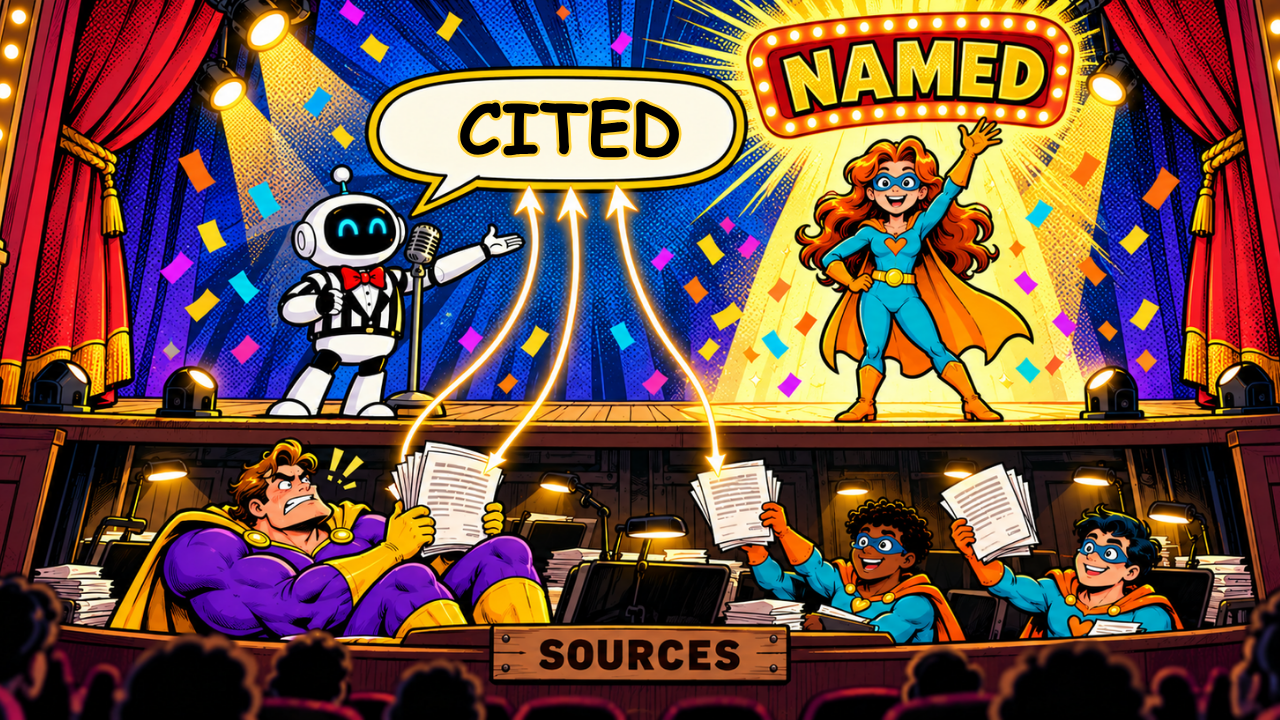

Belief 2 of 7 from the VizzEx AI Citation Study mid-study findings
346 Citations, 6 Namings: What Our Study Found
In the first eight weeks of our 12-week study, ChatGPT, Claude and Perplexity cited two of the most famous marketing publishers on the web as a source 346 times. The answers said their names 6 times.
In the same eight weeks, those engines cited the eight sites using VizzEx 3,384 times on questions that didn’t contain their names. They said those names 113 times.
So the sites using VizzEx were named about twice as often as the two famous publishers: the sites using VizzEx in 3.3% of the answers that used their pages, and the famous publishers in 1.7%. But look at the size of both numbers. The famous publishers were named in about 1 of every 58 answers that cited them. Even the sites using VizzEx were named in only about 1 of every 30.
Being in the sources and being in the answer are two different results. That gap is where this whole belief lives.
The Belief Being Tested: Cited Equals Recommended
“Being cited and being recommended are the same thing.”
People are starting to question this one. One of the best go-to-market voices on LinkedIn recently argued that the goal isn’t “visibility” anymore; it’s “winning the AI recommendation.” Readers agreed: 119 reactions, and a comment thread full of people nodding along.
Nobody in that thread had a way to measure it. The method proposed was to ask the model why it recommends what it recommends.
Why Asking the AI to Explain Itself Doesn’t Work
It sounds reasonable. But it doesn’t work, and the AI labs’ own research shows why: what a model says about its reasoning is often not what actually drove the answer.
Models Leave Out What Influenced Them
In 2025, Anthropic slipped hints into questions for two reasoning models, then checked whether the models admitted using them. Claude 3.7 Sonnet mentioned the hint it used 25% of the time; DeepSeek R1, 39%. When the models found a shortcut to game a task, they admitted it less than 2% of the time. (Anthropic, 2025)
They Construct a Plausible Story Instead
Researchers reordered the answer choices in their example questions so the right answer was always “(A).” The models’ accuracy dropped by as much as 36% across 13 tasks, and their explanations never mentioned the pattern that swayed them. They gave sensible-sounding reasons instead. (Turpin et al., NeurIPS 2023)
The Pattern Holds Even for Simple Arithmetic
When Anthropic traced what Claude does inside to add 36 and 59, it found the model running approximate calculations in parallel. Asked how it got 95, Claude described the schoolbook method: add the ones, carry the one. (MIT Technology Review, 2025)
Models Rarely Detect Their Own Internal States
In Anthropic’s October 2025 tests, its best model showed real awareness of what was happening inside it about 20% of the time. The researchers’ own advice: validate what models report about themselves. (Anthropic, 2025)
A model’s explanation isn’t worthless. A 2026 study of 18 models found explanations do help predict what a model will do, but 5–15% of them were badly misleading (Mayne et al., 2026). That makes an explanation a clue, not a measurement.
So we don’t ask. We’ve measured it directly since day one, because our method records two different things for every answer.
How we tested it
The VizzEx AI Citation Study is a controlled, 84-day experiment on live websites:
| Sites | 10 live websites across six industries |
|---|---|
| Treated sites | 8, running the VizzEx methodology |
| Control group | 2 famous marketing publishers, left untouched |
| Questions | ~1,200 real buyer questions, drawn from the sites’ own content |
| AI platforms | Google AI Overviews, ChatGPT, Claude, Perplexity |
| Schedule | Checked on a fixed schedule since July 25, with every raw answer stored |
One of the ten sites is ours, vizzex.ai.
Four Key Terms: Cited, Named, Recommended, and Absorbed
- Cited
- Your page is among the answer’s sources (the footnotes or source panel), whether or not the answer says who you are.
- Named
- The answer’s own text says your company’s name.
- Recommended
- Both at once. You’re cited and named.
- Absorbed
- Your idea is in the answer, sometimes nearly word for word, with no link and no name.
Most AI-visibility dashboards count the first one and call it visibility. We count all four, for every question, on every platform, every time we check.
Start with the controls: 346 citations, 6 namings
If being cited were being recommended, the two famous publishers in our control group would be recommended constantly. The AI engines use their pages all the time. That assumption is exactly what our control group study on SEO transfer was designed to test.
Across the first eight weeks, ChatGPT, Claude and Perplexity cited the two publishers 346 times on general topic questions. The answer text named them in 6 of those answers:
- four times, one publisher’s blog appeared by name in a list, on questions asking for the best SEO blogs and keyword tools;
- twice, an answer credited the other publisher by name for something it said.
At the webinar on September 22, we showed a single round of checks from five weeks into the study. In that round, on ChatGPT, Claude and Perplexity, the count was 41 citations and zero namings. (Google’s AI Overviews aren’t part of the naming count, for a reason we explain below.)
They weren’t alone. Here’s that same round of checks for every site in the study:
| Site (general topic questions, cited by an AI engine) | Times cited | Times named | Naming rate |
|---|---|---|---|
| vizzex.ai (the youngest site in the study) | 56 | 14 | 25% |
| Client site: healthcare | 15 | 2 | 13% |
| Client site: cybersecurity | 154 | 8 | 5% |
| Client site: reliability engineering | 104 | 2 | 2% |
| Four more treated sites | 69 | 0 | 0% |
| Two famous marketing publishers | 41 | 0 | 0% |
ChatGPT, Claude and Perplexity, one round of checks five weeks into the study, general topic questions only. Questions that contain the site’s own brand are left out, because the answer names the brand almost automatically there.
Naming Rates Across All Study Sites: One Round of Checks
Look at who’s at the top. The three sites that get named are the three whose content has names built into it:
- our own posts are full of named concepts;
- the healthcare client has its own named programs;
- the cybersecurity client has named frameworks.
The reliability engineering site is one of the most-cited sites in the whole study, and it sits at 2%. It is cited as a trusted source on question after question, and the answer almost never says whose content it is.
Citation vs. Naming Rates Across Three AI Engines: Eight-Week Data
Since the webinar, we ran the same count across every check in the first eight weeks, and split it by engine. These are questions that don’t contain the site’s own brand:
| Claude | ChatGPT | Perplexity | |
|---|---|---|---|
| The eight treated sites: times cited | 1,109 | 160 | 2,115 |
| … and named in the same answer | 9 (0.8%) | 38 (23.8%) | 66 (3.1%) |
| Two famous publishers: times cited | 85 | 0 | 261 |
| … and named in the same answer | 1 (1.2%) | — | 5 (1.9%) |
Google’s AI Overviews aren’t in this count: they print each source’s name as a link label, so there the name comes with the citation.
What the Engine-by-Engine Breakdown Reveals
Three things stand out:
- Claude uses your page and almost never says your name. It cited the treated sites more than a thousand times and named them 9 times.
- ChatGPT cites far less often, but when it does, it names the source about one time in four. ChatGPT is the hardest engine to get cited on and the most likely to say who you are once you are.
- Fame doesn’t change the rate. The famous publishers were named in about 1–2% of the answers that cited them, the same range as everyone else.
Across all three engines, 3,271 of the treated sites’ 3,384 citations were footnotes: 96.7%.
Same Page, Two Answers: How the Question Changes Whether You’re Named
Then the sharpest version, from the week before the webinar.
We have a comparison page on vizzex.ai that names our product and a competitor’s. We track two kinds of questions that the page answers:
Questions Containing Our Brand vs. Questions Containing Only the Rival
“VizzEx vs [rival], which should I use?”;
- questions that contain only the rival: “What are [rival]’s limitations?”
| The question contains… | Questions | AI checks | Our page cited | We’re named, when cited |
|---|---|---|---|---|
| Our brand and the rival’s | 8 | 162 | 98% | 100% |
| Only the rival | 8 | 186 | 15% | 4% |
ChatGPT, Claude and Perplexity, eight rounds of checks.
What the Comparison Page Data Shows About Naming
When the buyer’s question contains our brand, the answer names us every time. When the question contains only the rival, the same page is cited, the link is right there in the sources, and the answer names us about 4% of the time.
Same page. Same engines. Eight rounds of checks. The page didn’t change. The question did.
One more thing about that page. It has held its citations at every check, and on the questions that name both products, the rival’s own site almost never appears beside it: once in 27 checks. Our page holds about half of ChatGPT’s source slots on those questions (10 of 18). We haven’t seen the rival publish their own version of the page yet. When they do, we’ll measure it.
There Are Four AI Visibility States, Not Two: Recommended, Footnote, Known, Absorbed
Put the two measurements together and every answer falls into one of four states. Here’s how the treated sites’ answers split across the first eight weeks, on questions that don’t contain their brand:
| Named in the answer | Not named | |
|---|---|---|
| Cited (linked) | Recommended: 113 | Footnote: 3,271 |
| Not cited | Known by name: 27 | Neither: 20,672 (absorbed answers live here) |
The eight treated sites on ChatGPT, Claude and Perplexity: 24,083 answers.
- Footnote: linked but not named. Most wins in the study live here, including 340 of the controls’ 346. The engine used your page to build someone else’s answer.
- Recommended: linked and named. The source is shown and the answer says who you are. This is the result “winning the AI recommendation” means, and it’s the rarest of the three that involve you.
- Known by name: named without a link. The AI already knows you and says your name without needing to look you up. It’s rare, and it’s the most durable place to be. It’s also the one place fame showed up in our data: one of the famous publishers appears by name in “best blogs”-style lists 16 times on Claude and ChatGPT, without being cited.
- Absorbed: your idea is in the answer, with no trace of you. We come back to this cell in Belief 7, with the terms that leaked and the ones that didn’t.
Verdict: Being Cited and Being Named Are Two Different Jobs
Getting cited and getting named are two different jobs.
This is the finding that changed how we describe our own work.
The page decides whether you get cited. Whether an engine picks your page as a source comes down to the page: the question it answers, and how easily the engine can read and trust it.
The question decides whether you get named. Either your name is in the question, or your name is bound to the thing the question is asking about: a term you coined, a framework you named, a story only you can tell. If it’s neither, your page is a footnote under someone else’s answer.
What You Can Do Today to Separate Citations from Recommendations
1. Count how many of the questions you track actually contain your company’s name. Those are the only questions where being cited reliably means being named. On every other question, a citation is most likely a footnote. If nearly all your tracked questions contain your brand, your reporting is measuring the easy ground.
2. Report cited and named separately, engine by engine. A dashboard that adds them together can’t tell a footnote from a recommendation. Check Claude on its own: it may be using your pages hundreds of times without once saying who you are.
3. Find what on your site carries your name. Outside the questions that contain your brand, you get named when the question is about an idea that lives on your site: a term you coined, with one page that defines it and your name bound to it there. That’s Belief 7, and it’s where this series is heading.
What’s next
Belief 2 is the second of seven things everyone says about AI search that we put on a scoreboard. Still to come:
- whether schema markup is the fix;
- whether authority is the price of admission;
- whether citation volatility is random;
- whether head terms are the prize;
- whether more content is the answer.
The study ends October 17. At the end we’ll re-score every row on the board against the final data, including the predictions we filed at mid-study, whichever way they go.
Kim Albee is co-founder of VizzEx with Carolyn Holzman. The VizzEx AI Citation Study is a controlled, 84-day study of how Google AI Overviews, ChatGPT, Claude and Perplexity choose, keep and name their sources.
Frequently Asked Questions
What is the difference between being cited by an AI and being recommended by an AI?
Cited means your page is among the answer's sources (the footnotes or source panel), whether or not the answer says who you are. Named means the answer's own text says your company's name. Recommended means both at once. Being in the sources and being in the answer are two different results. That gap is where this whole belief lives.
How often do AI engines name a source they cite?
The famous publishers were named in about 1 of every 58 answers that cited them. Even the sites using VizzEx were named in only about 1 of every 30. Across all three engines, 3,271 of the treated sites' 3,384 citations were footnotes: 96.7%.
Why can't you just ask an AI to explain why it recommends a source?
What a model says about its reasoning is often not what actually drove the answer. Claude 3.7 Sonnet mentioned the hint it used 25% of the time; DeepSeek R1, 39%. When the models found a shortcut to game a task, they admitted it less than 2% of the time. A model's explanation isn't worthless, but 5–15% of them were badly misleading — that makes an explanation a clue, not a measurement.
Does having a well-known brand make AI engines more likely to name you in their answers?
Fame doesn't change the rate. The famous publishers were named in about 1–2% of the answers that cited them, the same range as everyone else. The sites using VizzEx were named about twice as often as the two famous publishers: the sites using VizzEx in 3.3% of the answers that used their pages, and the famous publishers in 1.7%.
Which AI engine is most likely to name a source when it cites it?
ChatGPT cites far less often, but when it does, it names the source about one time in four. Claude uses your page and almost never says your name — it cited the treated sites more than a thousand times and named them 9 times. ChatGPT is the hardest engine to get cited on and the most likely to say who you are once you are.