
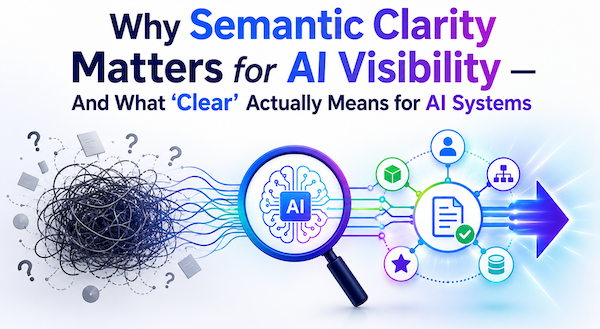

What Semantic Clarity Means for AI Visibility
Semantic clarity in content means that the meaning, relationships, and expertise signals in content are unambiguous to AI systems, not just to human readers. To ground this in first principles, understanding what semantic clarity in content means at the analysis level is the necessary foundation before evaluating how it determines AI visibility. A page can be beautifully written, well-researched, and even rank at the top of legacy search results while remaining semantically opaque to AI: its relationships to other pages are unmapped, its entity signals are weak, and AI retrieval agents cannot confidently verify its structural authority. Semantic clarity is the difference between a domain that an LLM silently digests and one that an LLM actively cites with live traffic referrals. Unlike traditional SEO signals, semantic clarity is not a property of individual pages. Semantic clarity is a measurable, pre-assembled property of the entire content domain.
Why “Good Writing” and “AI-Visible Writing” are Not the Same Thing
The digital publishing industry is currently trying to solve problems based on a severe diagnostic error. Agencies and enterprise brands are watching their search impressions collapse under modern core updates, and their default response is to hire more editorial writers, insert human-facing author bios, and double-down on traditional backlink building.
They are trying to solve a problem without even considering the physical mechanics of modern information retrieval (IR).
How AI Retrieval Agents Evaluate Trust and Structural Honesty
To an AI retrieval agent or a real-time RAG (Retrieval-Augmented Generation) system, “trust” and “clarity” are not subjective, human-centric attributes. An LLM does not read content with human eyes; it parses the document as a serialized stream of tokens, projects those tokens into multi-dimensional vector spaces, and calculates the mathematical probability that the website’s underlying structure is both honest and computationally efficient.
You can publish the most eloquent, expert article in your niche, but if its underlying HTML delivery system is bloated, if its internal hyperlinks lack relational declarations, and if its schema is unanchored from the what it looks like to humans, the AI’s parser will reject the page.
In the era of agentic retrieval, content quality is no longer an editorial goal, it is a physical, architectural specification. To survive, publishers must transition from writing for human reading only to compiling for machine ingestion. This shift is not merely stylistic—it represents a fundamental restructuring of how content domains are architected, and the transition from writing for human reading only to building expertise architecture is the foundational strategic move that most SEO and AI search tactics are still missing.
What Semantic Clarity Actually Means
To understand why semantic clarity has surpassed traditional relevance as the primary gatekeeper of discovery, we must map the physical transition of a web document through modern search engines. The following matrix contrasts legacy, keyword-first publishing strategies against the hardened, symmetric architectures required to clear the vector extraction pipeline:
| Ingestion Phase | Content Strategy (Input) | Semantic State (Vector Representation) | AI Action (Output) |
|---|---|---|---|
| Legacy Content | Textual Relevance & Keyword Stuffing | High Ambiguity & Fuzzy, Dispersed Vectors | LLM Guesswork (Ingestion Timeout / Citation Loss) |
| Symmetric Content | Structural Clarity & 1:1 DOM Parity | Zero Ambiguity & Hard Semantic Anchors | Deterministic Citation (Secure, Continuous Referrals) |
Clarity for Humans vs. Clarity for AI Systems
For a human reader, clarity is achieved through stylistic flow, active verbs, engaging formatting, and logical transitions. If a human can follow the prose and understand the conclusion, the page is clear.
For an AI system, clarity is achieved through determinism. An AI parser is searching for a mathematically unambiguous relationship between a subject, a predicate, and an object (entities and facts) within the DOM. If the parser has to allocate high-compute probabilistic reasoning (using LLM attention matrices) to figure out which entity the paragraph is referencing, the page is semantically opaque to a model.
The Four Dimensions of Semantic Clarity in Content
To be “clear” to an AI system, a document must satisfy four technical dimensions:
- Entity Singularity: Every core topic discussed on the page must be mapped to a singular, verifiable entity node in the global knowledge graph (e.g., grounding a topic to a Wikidata or Wikipedia URI) so there is zero linguistic ambiguity about what is being discussed.
- Relational Edge Mapping: Internal hyperlinks must not be flat, unstructured anchor text. They must act as relational edges that explicitly declare the relationship type (e.g., conceptual hierarchy, skill progression, or implementation cascade) between the source page and the target page.
- Structural Boundary Isolation: The page-level primary title (H1), author, and core authority text must be housed strictly inside the or tags. If critical grounding text lives in sidebars or dynamic headers, RAG splitters will strip them away as boilerplate.
- Zero-Variance Parity: The visible, rendered text on the page must maintain a 1:1 mathematical match with the page’s underlying schema markup (Algorithmic Parity) and the raw HTML source code (Symmetry Gate).
Why a High-Ranking Page Can Still Be Semantically Opaque to AI
This is the ultimate paradox of modern search. A legacy page can rank well in traditional search results purely on the momentum of its historical backlink profile. But when a real-time conversational search bot (GoogleOther or GPTBot) fetches that same page to synthesize a live answer, it bypasses the search cache.
Exposed to the live page’s unoptimized, dynamic, JS-reliant templates, the bot encounters severe connection latency and a massive HTML code tax. Bound by strict user-facing latency budgets (<150ms), the AI retrieval engine cannot afford the CPU overhead to render and parse the bloated layout. It instantly evicts the page from the active RAG citation queue, leaving the high-ranking site with a complete blackout in AI citations.
The Ghost Schema Fallacy: Why Flat JSON-LD Triggers AI Cloaking Flags
The single most common legacy SEO solution pushed by agency marketers is the mass injection of standalone JSON-LD schema markup. They assume that if they declare entities in their metadata, the AI will trust them.
This is a dangerous technical error. In an AI-native search ecosystem, flat, standalone JSON-LD schema does not work in a vacuum. The architectural distinction between legacy flat markup and a properly structured relational graph is explored in depth in the analysis of why flat, standalone JSON-LD schema does not work as a trust signal in modern AI retrieval pipelines.
If abstract metadata are claimed in the JSON-LD but fail to physically link those claims directly to visible, active DOM elements using stable IDs, the AI’s validation engine flags it as Ghost Schema. Because historical web spam relies on mismatching client-vs-crawler views (serving rich schema to bots while showing thin content to users), the system assumes a cloaking or manipulation risk.
If the machine cannot verify the metadata claims within the physical DOM, it downgrades the container’s structural fidelity, discarding the unverified schema as metadata noise and exposing the URL to silent RAG citation eviction.
Why AI Visibility Depends on Semantic Clarity
To understand why AI visibility depends on semantic clarity, we must transition from legacy search engine metrics to the physics of machine ingestion. AI systems evaluate web content through real-time vector representations and structured entity validation, meaning the site’s physical delivery cost determines its indexing eligibility. Below, we break down the core mechanics of how modern information retrieval (IR) systems parse, classify, and cite web documents:
How AI Systems Parse Content for Meaning — Not Keywords
Traditional search indexing relied on keyword frequencies, TF-IDF, and inverted document indexes. If a page matched the searcher’s words and had enough backlinks, they won.
Modern AI engines do not look at keywords. They convert the page’s text into dense vector representations (essentially GPS coordinates for meaning, locating where the ideas sit on a massive 3D map of concepts). The system measures the angle between vectors of a page relative to the user’s query. If content is vague, bloated, or covers multiple unrelated topics, the content’s vector representation becomes “fuzzy” and dispersed. This fundamental shift, where modern AI engines do not look at keywords but instead evaluate vector geometry, is precisely why SEO and generative engine optimization now operate under the same retrieval physics.
Semantic clarity forces a content’s vectors to align tightly with specific, highly authoritative concept centroids, ensuring the page is selected during real-time retrieval.
The Role of Entity Signals in AI Classification
AI models do not trust un-anchored text. They organize information through Entity Forcing, where every assertion made on the page must be mathematically tied to a verified entity (a specific brand, software application, person, or patent).
If a brand writes a guide about “data security” but fails to explicitly link that concept to a brand’s unique entity signature, the AI classifies the page as “anonymous consensus noise.” It absorbs the text to improve its own model, but refuses to cite the brand because the content failed to structurally prove ownership of the assertion.
Why Semantic Ambiguity Triggers RAG Eviction Despite Strong Rankings
If a page features a clunky heading hierarchy, vague internal links, or inconsistent entity naming, the AI’s semantic parser encounters high Semantic Entropy (cognitive uncertainty).
Even if a page ranks well on legacy Google Desktop, the AI’s RAG retriever will bypass the URL because the cognitive cost (GPU processing cycles) of extracting a clean, unambiguous answer from a messy document violates the scheduler’s Expected Return on Compute (ROC).
Compute Tax vs. Information Gain: The AI Citation Decision Matrix
Google’s systems are bound by real-time hardware execution thresholds and strict latency SLAs. If a competitor offers comparable Information Gain inside a clean, micro-efficient, and semantically clear container, the retriever’s scoring algorithms heavily favor that path of least computational resistance, leaving unoptimized, high-compute pages vulnerable to automatic latency eviction.
| Evaluation Metric | Low Information Gain (Common Knowledge / Average Consensus) | High Information Gain (Proprietary Facts, Data, Heuristics) |
|---|---|---|
| High Compute Tax (Dynamic Templates / Heavy JS / Sluggish) | ABSOLUTE BLACKOUT • Purged during high-speed raw crawls. • Immediate, complete deindexing. • Example: Automated, thin affiliate templates. | BRAND STRIPPING (The “Blind Ingestion” Trap) • Google pays the extraction cost once during updates. • The AI absorbs the unique facts and can justify deindexing the live URL. • Example: High-value content on heavy JS frameworks. |
| Low Compute Tax (1:1 Parity / Pre-Compiled Static HTML) | SILENT CRAWL • Page is indexed but rarely cited. • No unique value to recommend (consensus noise). • Example: Generic, rehashed definitions. | SECURE CITATION (The VizzEx Pro™ Standard) • Continuous RAG recommendations and active AI referrals. • It is cheaper for Google to cite the live URL than to train Gemini. • Example: High-UID content compiled on VizzEx templates. |
The Enemies of Semantic Clarity
Achieving semantic clarity requires more than just adding structured markup; it requires actively identifying and eliminating the structural friction points that trigger high-entropy penalties. When an AI’s layout-aware splitter encounters sloppy nesting or vague connections, it aborts the ingestion process. The following sections outline the most common technical enemies of semantic clarity currently triggering RAG eviction:
Vague Anchor Text That Doesn’t Declare Relationship Type
Using flat anchor text like “click here,” “read more,” or even standard keyword anchor text like “SEO guide” is a legacy failure.
To an AI, a link is a directed edge between two knowledge nodes. If links do not explicitly declare the relationship type of that link (e.g., declaring that the target URL is a conceptual_hierarchy sub-topic or a skill_progression next step), the AI is forced to guess how the pages connect, driving up its Compute Tax. The practical architecture for building these declared edges, including how relational edges that explicitly declare the relationship type are constructed and embedded at compile time, is covered in the implementation detail for semantic relationship links.
Pages That Cover Multiple Unrelated Topics (“Bloated” Content)
Publishing massive, 5,000-word “monster guides” that cover everything from basic definitions to advanced technical setups on a single URL is a major ingestion risk.
RAG splitters split documents into small semantic chunks (usually 100 to 500 tokens). If a single page covers multiple unrelated topics, its chunk vectors will conflict and collide, causing the document’s overall semantic footprint to fragment. To the AI, the page represents a high-entropy mess.
Inconsistent Entity Naming Across Posts
If you refer to core software as “Brand Name” on one page, “Brand Name Pro” on another, and “the plugin” on a third, you break the entity chain.
While a human can easily infer that these refer to the same thing, an AI’s semantic encoder treats them as separate entities, creating massive semantic ambiguity and breaking the site’s Topical Authority.
Missing Relationship Declarations Between Semantically Connected Pages
If a site hosts multiple highly valuable articles on a topic but fails to structurally link them together as a cohesive cluster, Google’s crawler cannot trace their semantic connections. They appear as isolated, orphan nodes, preventing the domain from establishing a strong Topical Vortex™ and leading to rapid citation decay.
The Weak vs. Strong Heading Problem (Heading Hierarchy Fractures)
Formatting that signals layout structure without signaling meaning is a major enemy of AI visibility.
- Weak Headings (Topic-labeling only): Headings like Process or Result
. These contain zero entity signal and are completely useless to an AI’s layout-aware splitter. - Strong Headings (Meaning-declaring): Headings like The VizzEx Pro™ Dynamic Compilation Process
. This explicitly declares the subject, the action, and the brand entity within the heading tag, ensuring that when the document is chunked, the semantic vector remains tightly anchored to the brand.
AI-First Web Infrastructure: Technical Requirements to Prevent RAG Eviction
To prevent automated RAG eviction and secure sovereign citations across the universal AI supply chain, an enterprise website must transition from standard document-delivery layouts to a coordinated, compile-time metadata compiler.
Below is the streamlined technical matrix mapping critical AI-ingestion barriers directly to their required architectural standards and their automated resolution:
| Core AI-Ingestion Barrier | Required Architectural Specification | The Automated Resolution |
|---|---|---|
| The Ingestion Penalty (High Compute Tax)
Googlebot and LLM scrapers deindex URLs that are too expensive to render. |
Compile-Time Symmetry (Zero-Variance)
Raw HTML payloads must maintain 1:1 parity with the rendered visual viewport layout (The Symmetry Gate). |
VizzEx Pro™ Compiler Engine
Executes real-time compilation at the server origin, delivering an absolute $0.00$ variance between structural metadata and visual DOM elements out-of-the-box. |
| Linguistic Ambiguity & Consensus Dilution
AI engines declassify generic industry vocabulary as public knowledge, stripping brand attribution. |
Unified Defined Terms Schema Mapping
Core concepts, proprietary terms, and methodologies must be mapped to a machine-readable DefinedTermSet. |
VizzEx Pro™ Intelligence Dictionary
Operates a centralized, server-level term schema, dynamically binding and mapping the brand’s core proprietary terminology across the entire domain graph. |
| Relational Guessing (Asymmetry Failures)
AI crawlers fail to map the site structure, leading to Ghost Schema flags and dropped citations. |
Automated Relational Edge Annotation
Internal hyperlinks must be annotated at compile time with nested Role schema edge declarations to define relationship types. |
VizzEx Pro™ Edge Annotator
Automatically annotates physical HTML anchors on compilation, outputting structured roleName parameters to define relational hierarchies directly to RAG parsers. |
| Vector Fragmentation
Stacked headings and layout clutter create empty parent nodes, disrupting semantic vector creation. |
Meaning-Declaring Header Serialization
Every header tag must be self-contained, meaning-declaring, and separated by structural paragraphs. |
VizzEx Pro™ Structural Compiler
Isolates core content strictly within structural <main> or <article> boundaries, flattening DOM trees and ensuring pristine H-tag hierarchies. |
| Citation Decay
Isolated pages lack semantic connection to the parent entity, failing the Connectivity Gate. |
Horizontal Content Integration
Pages must be structurally bound to the domain’s overarching entity-topic structure, establishing a Topical Vortex™. |
VizzEx Pro™ Horizontal Analyzer
Monitors and compiles the site’s entire graph, generating structural relationship vectors that prove topical authority and qualify for RAG citation longevity. |
Semantic Clarity Audit Checklist: 7 Pre-Publish Questions for AI Visibility
Before publishing any document to the web, the development and editorial teams need to run this technical audit:
- Does the primary H1 contain a meaning-declaring entity, or is it a vague topic label? (Pass if it contains a verified entity; fail if it is generic).
- Are there any stacked headings without intermediary paragraph text? (Fail if an H2 is followed immediately by an H3; heading isolation must be maintained).
- Are the H1, bylines, and core authority text housed strictly inside the tag? (Fail if any of these critical elements live in headers or sidebars outside ).
- Does the meta description match the JSON-LD “description” property with 1:1 word-for-word parity, and is it under 150 characters? (Symmetry Gate compliance).
- Does every abstract schema node map directly to a physical, visible HTML element with a matching stable ID? (Symmetric Schema Binding verification).
- Are there any unlinked entity claims in the JSON-LD? (Fail if a declared schema entity lacks a corresponding physical DOM anchor path).
- Do all internal hyperlinks in the body explicitly declare their relationship types via schema Role nesting? (Relational Edge verification).
Semantic Clarity and VizzEx’s Horizontal Analysis
To ensure a content domain is ready for continuous AI induction, we must move beyond page-by-page auditing and evaluate the site’s overall semantic architecture. VizzEx’s horizontal analysis framework is engineered to scan the entire crawl graph, surfacing the structural gaps that legacy page-level tools miss.
How Horizontal Content Analysis Surfaces Semantic Clarity Gaps
Traditional page-level SEO auditing tools are blind to semantic architecture. They scan single pages for keywords and broken links, completely missing how the site-wide crawl graph behaves.
VizzEx’s Horizontal Content Analysis operates at the semantic level. Instead of searching for technical code errors, it maps an entire domain’s internal link infrastructure to surface all the connections and relationships between the posts. By analyzing how the pages are interconnected, it provides the specific semantic and relationship connections (such as parent-to-child hierarchies or conceptual cascades) that define the site’s overall topical footprint. This allows a visualization of content as a cohesive, un-fragmented knowledge graph rather than a collection of isolated posts.
The Symmetry Parity Ratio and Flash-Induction Velocity (FIV)
To audit and quantify a domain’s readiness for real-time AI and RAG ingestion, there are two core, system-level engineering benchmarks to track:
The Symmetry Parity Ratio (Symmetry Score)
Calculated by the free diagnostic scanning engine at symmetrygate.ai, this metric measures the exact raw-HTML-to-rendered-DOM alignment (ranging from $0.00$ to $1.00$). Any ratio below $1.00$ indicates a visual-to-code mismatch (Symmetry Gate failure), exposing the URL to immediate citation eviction.
Flash-Induction Velocity (FIV)
The end-to-end measurement of a server’s real-time data-extraction and delivery speed. While you use the free scan at symmetrygate.ai to diagnose your Symmetry Parity Ratio, the commercial installation of VizzEx Pro™ on the server is what actually compiles and locks in a perfect 1:1 parity score and reduces FIV to under 150 milliseconds (the threshold for continuous, live AI overview citations).
These metrics split pages into three distinct diagnostic states:
Tier 1: Continuous Induction (Symmetry Parity = 1.00 / FIV < 150ms)
Clean server floor (Gate 0/1 pass), 1:1 DOM-to-Schema parity, and complete Relational Edge Mapping. The domain is fully exempt from HCU penalties and enjoys continuous, real-time RAG citations.
Tier 2: Probationary Trust (Symmetry Parity = 1.00 / FIV = 150ms – 500ms)
The site has high-quality content and passes the visual Symmetry Gate, but carries minor Compute Tax (e.g., slow redirects or un-optimized template latency). The site is cited occasionally but suffers from citation decay.
Tier 3: Eviction Risk (Symmetry Parity < 1.00 / FIV > 500ms)
High Compute Tax, un-remediated server floor, and unanchored Ghost Schema. The site is actively locked in a High-Compute Audit loop, completely excluded from live AI Overview citations.
Frequently Asked Questions: Semantic Clarity, Compute Tax, and RAG Citations
To help clarify the technical distinctions of the AI-first search environment, we have compiled answers to the most frequently asked questions regarding semantic clarity, Compute Tax, and RAG citation mechanics:
What is the difference between semantic clarity and keyword optimization?
Keyword optimization focuses on matching specific text strings. Semantic clarity focuses on eliminating relational and ontological ambiguity. Keyword optimization is designed for legacy document indexes; semantic clarity is designed to pass modern AI vector-mapping and Knowledge Graph validation.
Can a high-ranking page in Google still be semantically unclear to AI?
Yes. A page can rank well in traditional search based on its legacy backlink authority while remaining semantically opaque to AI. When real-time retrieval bots attempt to parse the page, the server’s high latency and dynamic code tax violate the 150ms real-time RAG budget, triggering immediate citation eviction.
Why does Google crawl my site heavily if I am not getting cited?
Googlebot continues to crawl penalized or un-optimized sites to keep its database fresh. However, if a site carries a heavy Compute Tax (1,500ms+ latency and bloated payloads) and lacks semantic clarity, the crawling engine continuously labels the pages as “Crawled – currently not indexed,” trapping the page(s) in a perpetual, expensive High-Compute Audit loop.
How does VizzEx Pro™ secure my brand’s RAG citations?
VizzEx Pro™ compiles the dynamic site layouts natively at the server level, delivering visual elements directly in the initial static HTML payload. By executing Symmetric Schema Binding, it locks the logical schema nodes directly to physical DOM element coordinates. This drops Google’s extraction cost to near-zero, removing their economic incentive to steal a brand’s facts and ensuring they choose the cheaper path of citing the brand’s live URL.
The Real Battleground of AI Visibility: Computational Economics Over Content Quality
The belief that “content quality” and backlinks are enough to win in the era of generative AI is a fatal misunderstanding. Modern search is governed by the laws of thermodynamics and computational economics.
If high-value insights are delivered inside a clunky, slow, and semantically vague container, the AI will digest the intellectual property, strip away the brand name, and be more likely to evict the live links.
To protect a brand and secure permanent, high-traffic RAG citations, the site must be computationally cheaper to cite than to ingest. By securing the server floor, purging legacy keyword-stuffing patterns, and implementing VizzEx’s Symmetric Schema Binding™, the physical and logical gates of modern retrieval are clear, transforming the content library into a zero-friction, highly visible AI authority engine.