
Our Research
Original research specifications from the VizzEx Strategic Research Hub, led by Carolyn Holzman — versioned, citable, and built to serve as primary sources for practitioners navigating the AI search era.

Every Tool Claims to Win AI Search. Here’s What They Actually Do
A plain-language guide to the content tool landscape for B2B marketing leaders — what each category actually solves, what the entire industry missed, and how to build a stack that makes AI systems cite your expertise. The Problem With "AI Search" Vendor Pitches If...

Why Semantic Relationship Links Are Critical for AI Visibility (And How VizzEx Creates Them)
How to Analyze Your Entire Blog for Semantic Relationship Links That Boost AI Visibility When someone asks ChatGPT, Claude, Perplexity, or Google's AI Overviews a question in your domain, does your content get cited? For most B2B companies with 50-200 blog posts, the...

What Is Semantic Content Analysis?
The Missing Layer Between Great Content and AI Discoverability You've spent years building your expertise. You've published dozens, maybe hundreds, of blog posts. You know your stuff inside and out. But here's the question that should keep you up at night: Can AI...
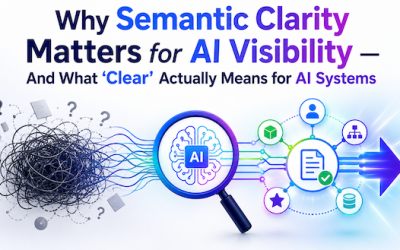
Why Semantic Clarity Matters for AI Visibility — And What ‘Clear’ Actually Means for AI Systems
What Semantic Clarity Means for AI Visibility Semantic clarity in content means that the meaning, relationships, and expertise signals in content are unambiguous to AI systems, not just to human readers. To ground this in first principles, understanding what semantic...

AI Search Optimization Tools for SEOs Who Feel Directionless: What Actually Works in 2026
If traditional SEO tactics feel increasingly disconnected from actual results, you're not imagining it, and you're not alone. The shift from ranking-based optimization to answer-engine visibility requires a fundamentally different toolset. But here's the deeper...

Vertical Search vs. Horizontal Search: What the Difference Means for AI Visibility
A horizontal search engine — like Google — crawls the entire web and returns results across every topic and content type. A vertical search engine narrows its index to one domain: products, jobs, images, or academic papers. Understanding the difference isn't just a...

When Link Whisper Isn’t Enough: What Internal Linking Is Missing in the AI Search Era
Link Whisper is a solid tool for building internal links efficiently. But efficient linking and strategic linking are two very different things. If your blog has hundreds of internally linked posts but still isn't being cited by AI search engines, the problem isn't...

The “AI Decoy Website” Trap: An Algorithmic Suicide Squeeze Play
On Bluesky, Google’s John Mueller recently issued a blunt warning regarding web development priorities in the age of artificial intelligence: "A properly made website works well for AI agents... and search engines, and LLMs, and above all, for actual people. If...

Why Sites Not Ranking in Google Can Rule in the ChatGPT RAG Pipeline
For SEO search directors and senior technical SEOs, our industry is witnessing a glaring operational divergence: Websites that are completely invisible in Google’s organic search results are simultaneously driving tens of thousands of citations inside ChatGPT. To...

The Brand Stripping Penalty: Why AI Search Engines Steal Your Expertise and Erase Your Referral Links
The Dangerous “Rent-vs.-Buy” Paradox of AI Search, and How to Force Continuous Brand Citations Digital marketing agencies and enterprise brands are currently experiencing a silent, devastating crisis. Following recent algorithmic updates, high-authority websites that...

What Two AIs Revealed About How AI Search Actually Decides What to Cite
I asked ChatGPT and Claude the same question. One found my company in eight seconds. The other never could. Here is the machinery that explains why, and what it means for whether AI can see your expertise.

Detecting Brand Bias in Comparison Pages: The Illusion of Field Data in Light of Structural Reality
Moral Tuning Myth vs. Compute Optimization Reality in AI Retrieval A persistent, mainstream SEO discourse argues that search and artificial intelligence engines (such as Google and OpenAI) are actively "moral tuning" their retrieval models. They are suggesting that...

Schema is no longer Schema: Flat Schema vs. VizzEx Relational Graphs
Why Flat Schema Is Now an Active Ingestion Risk For over ten years, we were trained to think that 'schema is schema'—as long as the validator was error and warning free, we were done. But that was “browser schema”. That was “flat schema” designed to make your...

The Death of PageRank Sculpting – How AI Ingestion and Chunk-Autonomy Redefine Web Linking Architecture
PageRank sculpting — the practice of controlling link equity flow by selectively adding or removing internal links — was a legitimate SEO strategy when Google's ranking system primarily relied on link graph analysis. That era is over. AI search engines don't flow...

Bypassing the Copilot Agentic Loop Through its Tri-Engine Architecture
If you have been following Microsoft’s aggressive integration of Copilot, you already know that the architecture of AI search has shifted beneath us. We are no longer in a world of simple keyword retrieval, where an AI crawls a page and summarizes a snippet. We are in...

The HCU / LLM Parity Matrix: Why “Helpful” Means “Architectural Trust”
Objective: Mapping HCS and LLM Evaluation to a Single Trust Audit To demonstrate that Google’s Helpful Content System (HCS) and Large Language Model (LLM) Extraction engines are evaluating the exact same structural elements, just under different names. This is the...

How to Bypass the Agentic Loop: The Architecture That Skips the Compute Tax Entirely
Why Smarter AI Retrieval Penalizes Noisy Content If you have been following the recent work of Michael King and other senior technical voices in the Agentic RAG space, you already know the architecture of AI search has shifted underneath us. We are no longer in a...

The AI Visibility Tracking Trap: Why Your Dashboard Is Measuring Noise
AI visibility trackers report a “ranking” that changes hour to hour. Here’s why that number is noise, and the structural fact you should measure instead.

The ClickUp SEO Autopsy: Helpful Content is a Math Problem, Not a Moral One
April 2026 has yielded a landmark case study in SEO: The collapse of the ClickUp blog. With a 97.6% drop in organic visibility over 15 months, the industry is scrambling to explain how a DR 90+ authority site could fall off the face of the earth. Why the 'Moral...

Horizontal Content Analysis Definition
The Shift from Vertical SEO to Horizontal Content Analysis For over a decade, the SEO playbook has been remarkably linear: identify a keyword, write a comprehensive article, optimize the headings, and build backlinks to that specific URL. This approach of optimizing...

The 56% Grounding Gap: Why Google Can’t Trust the Noisy Web
The New York Times recently published a diagnostic of Google’s AI Overviews that confirms the exact "Signal Crisis" VizzEx was engineered to solve. The data is startling: While Google’s Gemini 3 is accurate 91% of the time, more than half of those responses (56%) are...

Why Fake Local News Site Hijacks the Induction Era
How a Fake Local News Site Tripled Traffic During Google's 2026 Spam Update In March 2026, as Google’s Core and Spam updates tore through the search results, a startling field observation emerged in the aftermath: a five-year-old "Fake Local News" site was not just...

The Mathematical Reality of the 4.5-Week Citation Half-Life
The "Rented" Visibility Trap What the Scrunch Data Actually Reveals About Citation Decay In March 2026, the Scrunch study of 3.5 million AI citation events revealed a "brutal" new reality for the industry: the average AI citation loses 50% of its presence in...

Engineering Signal Integrity for the GPT 5.4 “Truth Audit”
The “Brutal” Reality of AI Search in 2026: The VizzEx ADC Assessment In March 2026, Chris Long of Nectiv shared his observations of changes Chat GPT has brought to search by how “It evaluates WAY more sources + looks for trust/authority signals.” Our industry is...

The Invisibility Penalty: How Hidden Content Corrupts Your Signal in the Age of AI
How Google's AI Crawler Family Detects Hidden Content I’ve been studying the process of the indexation of content into Google’s indexation system for almost five years with nearly daily indexation tests confirming the first (html) and second (javascript rendering)...

The Reverse Engineering Trap: Why Optimizing for the “Average Answer” is Killing Your AI Visibility
The AI Authority Illusion: When Statistical Averages Mimic Expertise VizzEx Research Artifact | Ref: VZX-AAI Definition: The AI Authority Illusion is a phenomenon where Large Language Models (LLMs) misattribute "Established Authority" to high-volume enterprise...

Semantic Geometry Bridges Legacy Search and Autonomous AI Discovery
The 100% Indexation Breakthrough For over a year I’ve been testing a simple structural ratio which yields 100% indexation rate. As an indexation nerd, I am compelled to make the distinction between indexed and served. They are two separate sub-systems in the Google...

VizzEx vs. RankYak: Two Very Different Strategies for AI Search Dominance
The Central Question Facing Every Content Team Content Volume vs. Semantic Architecture: Which Strategy Wins With AI Search? Every serious content team is asking the same question right now: How do we show up in AI answers — in ChatGPT, Claude, Perplexity, Google AI...

VizzEx vs. InLinks: Two Very Different Answers to the Same Question: How Should Your Content Connect?
VizzEx vs. InLinks: What's Actually Different? If you've been researching internal linking tools, you've probably run into both InLinks and VizzEx. They both use the word "semantic". They both analyze your blog. They both help you build connections between your...

VizzEx vs. ThatWare: Two Different Tools, Two Different Jobs — And Why Self-Service Matters
A guide for content marketers evaluating their AI visibility and content optimization stack VizzEx vs. ThatWare: What This Comparison Actually Covers If you're trying to make your content visible to AI systems — ChatGPT, Claude, Perplexity, Google's AI Overviews —...

What is the AI’s Autonomous Discovery Cycle? (And Why You Want to Be in It)
The "Average Answer" Based on a Legacy System Last week I began a conversation with Gemini about duplicate content on websites and the conversation took me to a new place understanding LLMs. I feel like the brother-in-law in Field of Dreams when he went from not...

The One Site Type Google’s Helpful Content Update Can’t Tame: News
Horizontal Topical Measurement My Helpful Content analysis theory began with two years of indexation testing data and it revealed there was some horizontal topical measurement between the pages on the domain. The more topical variance, the less the indexation rate....