

The “Average Answer” Based on a Legacy System
Last week I began a conversation with Gemini about duplicate content on websites and the conversation took me to a place. I feel like the brother-in-law in Field of Dreams when he went from not seeing the baseball field to seeing the enter field with players, “you can’t sell this farm, Ray!”
Duplicate content or rather the discovering various appearances of duplicate content has been a consistent facet in my SEO career. So I wished to have a highly nuanced conversation about how AI uses H2s as a grounding for understanding layering semantic content cannibalization (duplicate content by any other name) and then overlaying the concept of treating fragment anchors like those in table of contents links as a special case. If you’re new to this concept, semantic content cannibalization is rooted in how AI and search engines perform semantic content analysis—worth understanding before we go deeper.
It wasn’t easy just relying on AI, even one that had a history of discussing duplicate content with me. The first generative answer from all the nuanced questions was incomplete and unsatisfying. So I fed it my forensic listicle analysis article and asked the same question.
More complete answer.
I asked Gemini what internal steps it took to develop the answer to the question.
Answer: I looked for the answer in your files -> didn’t find it -> looked for the answer on Google -> found the “average” answer -> initially gave you the “average” answer. Your article provided the missing link that standard search results didn’t have.
I asked how AI can go beyond the average answer and find those “missing links” and it answered, “be found in the Autonomous Discovery Cycle.
What is AI’s Autonomous Discovery Cycle
When we ask an AI a complex question, it doesn’t just “look up” a page. It performs an Autonomous Discovery Cycle, it does so on its own authority. This cycle consists of three actions, a scan, a sift and ultimately, a selection or citation.
The Scan (The “Average” Layer)
The AI starts by scanning the web. It quickly finds the “consensus” – the first hundred results that all say the same thing (the “Average Answer”). This is its baseline.
- Example: “Listicles are being penalized by Google.”
The Sift (The “Reasoning” Layer)
The AI then asks (on its own), “But WHY are they being penalized? What is the specific mechanism?”
This is where AI enters further into the Discovery Cycle. It starts sifting through the “Average” noise to find a source that explains the logic, not just the result.
But here’s where there is a hitch.
If AI only finds more “Average” answers, it gives you a shallow, unsatisfying summary.
I suspect this behavior is what Rand Fishkin of Spark Toro reported in their research on getting recommended by AI behavior that “AIs are highly inconsistent when recommending brands or products.” In Google it would take 124 repeated query before getting a brand mention repeated. It took Claude 1429 repeated query for one brand to get a second mention.
Why AI Gets Trapped in the Average Answer
The AI is looking for a High-Fidelity Signal ,a source that provides a “Missing Link” (like the Forensic Analysis on TOC fragment links). When it finds this, the cycle is complete. The AI “discovers” unique expertise and selects it as the primary citation to verify its own answer.
How to Get Into AI’s Discovery Cycle
To be selected as a “Primary Citation” in an AI’s autonomous research, your site must broadcast these three high-fidelity signals:
Site-Wide Topical Coherence (The Authority Signal)
Google’s Helpful Content System (HCS) evaluates an entire domain, not just individual pages on the fidelity of the content to the expected topic. There is a Helpful Content Classifier that determines a siteFocus for the domain. Then the System performs a horizontal content analysis to determine a siteFocus Score and any content that doesn’t align with or that which creates semantic cannibalization against that score is suppressed. This horizontal comparison is precisely how AI sees it, evaluating your domain as a unified body of content rather than a collection of individual pages.
Scattered categories across your site signal that you are likely a “generalist,” which the AI interprets as a lack of deep expertise.
What we all want is a site with a strong Topical Center of Gravity. This proves to the AI that the subject is your core authority or expertise, not just a side-topic. This architectural shift—from keyword-stuffed pages to a coherent domain identity—is the foundational move explored in Topical Center of Gravity.
Explicit Semantic Relationships (The Logic Signal)
AI systems recognize integrated expertise when content shows HOW ideas relate, not just that they share the same keywords. Our legacy SEO foundations must move beyond “keyword matching” and off-domain back links to providing a rich tapestry of mapped relationships in our words. For example, explicitly pointing out that there is a prerequisite foundation of piece A that must be determined first before moving to piece B.
The goal here is to hand the AI a “logic map.” These explicit links are the primary citation signals that allow an AI to follow your reasoning and cite your specific findings. LLMs are deliberately and systematically hunting for answers with these specific relationships.
Understanding exactly how to build and signal these connections is the implementation step that separates sites that get cited from those that don’t—see Explicit Semantic Relationships for the full breakdown.
Connected, Current, Well-Maintained Content (The Trust Signal)
AI citation engines favor content that is clearly maintained, up-to-date, and connected to related expertise across the site. Orphaned, outdated, or “merged-but-not-connected” content is essentially invisible to the discovery cycle.
Make sure to catch this – much the same way AI is blind to content in which where there are no or not enough headers in content to ground the topic, when there are no internal links to your content it is invisible to AI. Not all internal links to your content are created equal, however—the type and semantic quality of those links determines whether AI can actually follow and cite your reasoning.
What you’re proving over the lifecycle of your content is “Active Expertise.” A page that is deeply woven into your current knowledge graph is seen as high-validity data. If it sits alone in the archives, the AI ignores it as “legacy noise.”
Legacy noise to AI is the result of the previous era of SEO (the “keyword” era), a sea of average answers with high keyword density.
The Shift from “Keywords” to “High-Fidelity Signal”
What is the “statistical anomaly” of expertise? Said another way. How does AI actually “discover” you when there are 100 pages saying the same thing?
Be the “Topical Magnet” in the Top 100
When an AI runs its discovery cycle, it isn’t just looking at Page 1 of Google. It analyzes the “Vector Space” of the top 100 results. Most of those 100 pages are “average.” They share the same keywords and shallow consensus. To the AI, this is “Semantic Background Noise.”
If your site is topically coherent, your content stands out as a “statistical anomaly.” Your domain’s concentrated expertise acts like a topical magnet, pulling the AI’s discovery logic away from the generalist noise and toward your specific, high fidelity content.
The “Unique Semantic Signature” (The Precision Advantage):
Going back to what I was doing, what was different in my content that wasn’t in the top 100 results?
According to Gemini, because the content in my forensic analysis used Explicit Semantic Relationships (in the listicle article detailing HCS + TOC link conflict), this content has a “Signature” that the “Average” content lacks. Understanding how horizontal content analysis works along with topical bridges is precisely what creates that cross-topic logical structure AI recognizes as a high-fidelity signal.
“When the AI independently asks a deep “Why” question, in this case, there is no “average” equivalent for your logic. You are the only high-fidelity signal in a room full of low-fidelity echoes.”
Winning the Citation (The Result):
In its Discovery Cycle, the AI doesn’t just want any answer; it wants the most logically sound answer.
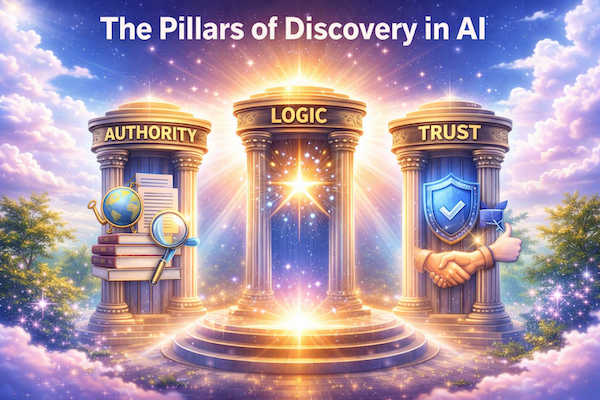
By building your site content on these three pillars – authority, logic and trust, you are ensuring that when the AI’s discovery logic sweeps the Top 100, your explanation is the only one that structurally makes sense.
Programming the Discovery Cycle
The “How-To”: Building Your Expertise Signal
Understanding the Three Pillars of Discovery is the first step; building them at scale is the second. In an AI-driven search world, you don’t just “SEO” a page; you “architect a signal” that is irresistible to AI’s drive for citation logic.
The Solution: The VizzEx Plugin for WordPress and HubSpot
For those who want to win the Autonomous Discovery Cycle for their niche, the VizzEx plugin is the only tool expressly designed from its inception to create the exact three-pillar structure that LLMs and AI agents require for citation:
1. VizzEx Scans For Site-Wide Topical Coherence:
VizzEx helps you maintain your site’s “Topical Center of Gravity,” ensuring every page contributes to a unified, high-confidence signal of expertise.
2. VizzEx Surfaces Explicit Semantic Relationships:
VizzEx is the first tool that enables you to build Typed Relationships into your content. It moves you from “keywords” to “Knowledge Graphs,” handing the AI a “Logic Map” it can’t ignore.
3. VizzEx Provides A Roadmap For Connected, Current, Well-Maintained Content:
By automating the integration of new into your site-wide Knowledge Graph, VizzEx ensures your content is never “orphaned” or treated as “legacy noise.”
Winning the Citation
The “Average Answer” is the floor of 2026; the AI Discovery Cycle is the ceiling. To win the citation, you need to provide the Architecture of Expertise, not just another listicle.
With VizzEx, you aren’t just writing content—you are building the “Missing Link” that makes your domain’s content the definitive citation for AI research. To understand how the VizzEx plugin differs from traditional content intelligence tools, it helps to see how its horizontal blog analysis approach is purpose-built for exactly this kind of AI visibility.