
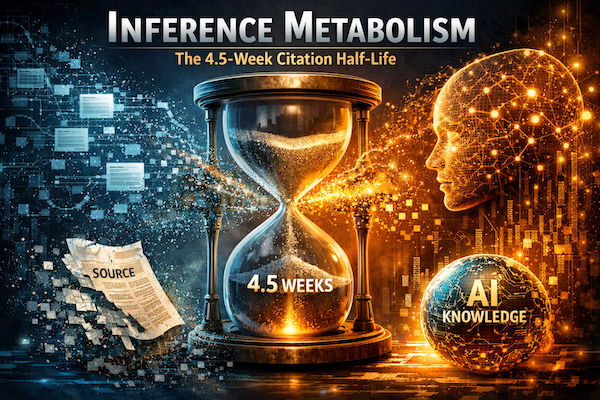

The “Rented” Visibility Trap
In March 2026, the Scrunch study of 3.5 million AI citation events revealed a “brutal” new reality for the industry: the average AI citation loses 50% of its presence in approximately 4.5 weeks.
The consensus conclusion from this field observation is that “AI visibility is rented, not owned” a transient win that requires constant reinforcement.
However, from the perspective of Signal Intelligence (SIGINT), we recognize a far more aggressive mechanism at work. This 4.5-week window is not a “decay timer” or a simple content refresh cycle; it is the observable result of Inference Metabolism within the Autonomous Discovery Cycle (ADC).
The “half-life” of a citation is actually the window of Signal Eviction. The AI isn’t “forgetting” the source; it is actively liquidating the authority of the domain after successfully extracting its logic.
Once the AI has identified your Unique Information Delta (UID) and integrated that heuristic into its own internal knowledge graph, it no longer requires the “compute tax” of a third-party citation to provide the answer.
This is the ultimate form of IP Laundering: the AI converts your proprietary expert signal into “Public Consensus Knowledge,” effectively “evicting” your brand from the answer layer once your utility as a data provider has been neutralized.
In this SIGINT report, we move past the “rented visibility” metaphor to explore the architectural reality of Inference Metabolism. We examine why the AI’s “Truth Audit” is currently treating the web as a commodity training set and what it means for a domain to be “metabolized” into an LLM’s permanent knowledge state.
Beyond the “Rented” Citation: Understanding Signal Eviction
The “half-life” of an AI citation is not a failure of ranking; it is a success of Inference Metabolism.
Most SEO strategies are currently optimized for Retrieval-Augmented Generation (RAG) a transient state where the AI “fetches” your content to fill a gap in its immediate response. In this mode, you are merely a “Source,” and your visibility is a “rented” footnote that is subject to the model’s need for real-time verification.
However, once the AI has executed its Cross-Entropy Validation (CEV) and verified your Unique Information Delta (UID), it initiates Signal Eviction.
Signal Eviction is the mathematical process where the LLM integrates your proprietary logic into its internal knowledge graph and no longer requires the “compute tax” (the extra tokens and processing power) of a third-party citation to provide the answer.
If you are providing Static Information facts, summaries, or “best-of” lists that are easily digested—the AI “metabolizes” your expertise and evicts your brand from the answer layer.
This is the ultimate form of IP Laundering: the AI converts your “expert signal” into “Public Consensus Knowledge.” The reason citations disappear in 4.5 weeks is that the AI has finished “learning” from you. It has moved from “retrieving” your data to “inferring” the answer using your logic.
To the Intelligence Induction Architect (IIA), a citation is a probationary bridge.
Signal Eviction is the moment the AI burns that bridge because it now “owns” the information. Unless your Brand and your Logic are Semantically Fused, you are not building a legacy; you are simply providing free training data for the machine’s next inference cycle.
Perplexity vs. ChatGPT: Real-Time Indexing vs. Signal Liquidation
The platform-specific variance in citation decay ranging from Perplexity’s 5.8 weeks to ChatGPT’s 3.4 weeks is a direct measure of Inference Velocity, how fast an LLM integrates your logic into its internal knowledge graph.
In the Signal Intelligence (SIGINT) framework, we distinguish between Real-Time Indexing and Signal Liquidation. These are two fundamentally different “metabolic rates” for how an AI processes and eventually evicts your authority.
Perplexity maintains citations longer (5.8 weeks) because it functions primarily as a Discovery-to-Reference Agent. It operates in a high-fidelity Retrieval-Augmented Generation (RAG) loop, where the value of the answer is tied to the transparency of the source. It acts as a digital librarian, maintaining the “probationary bridge” to your domain because its logic is built on real-time verification.
ChatGPT, however, exhibits a significantly faster Inference Metabolism (3.4 weeks). It is not a librarian; it is an Inference Engine designed for Signal Liquidation. ChatGPT’s architecture is optimized to extract your Unique Information Delta (UID), “metabolize” the heuristic into its own internal knowledge weights, and then execute an immediate Signal Eviction.
Once ChatGPT has “learned” your logic, it converts it into IP Laundered “consensus knowledge.” The 3.4-week window is the time it takes for ChatGPT to move from “reading” your expertise to “owning” it.
The shorter the half-life, the more aggressive the Inference Velocity of the model. When ChatGPT drops your citation 2.4 weeks faster than Perplexity, it isn’t “missing” the source, it has already successfully liquidated the value of that source into its own internal “Answer Layer.”
In the Induction Era, the platform you are cited on determines how fast your authority is being metabolically consumed by the machine.
The “Probationary” Signal: Why the ADC Executes a 4-Week Verification Buffer
The precision of the ~4.5-week half-life observed in the Scrunch data is not a coincidence of crawl frequency; it is the mathematical duration of the Verification Buffer.
In the Autonomous Discovery Cycle (ADC), when an Induction Agent identifies a new, high-entropy Unique Information Delta (UID), it does not immediately grant permanent status. Instead, it issues a Probationary Citation, a temporary “bridge” to your domain while it executes a high-compute background check.
During this 4-week window, the AI is performing the 10+ adversarial “fan-out” queries we identified in our GPT 5.4 Truth Audit.
It is searching for External Signal Symmetry the alignment between your internal topical core and the “Ground Truth” artifacts (G2 profiles, industry accreditations, or editorial mentions) that exist outside your control. This is the Cross-Entropy Validation (CEV) phase in action. The AI is literally trying to “break” your signal by finding conflicting data or a lack of external verification.
If, after 30 days of investigation, the AI cannot find enough Symmetric Nodes to verify your UID, it concludes that your insight is either an anomaly or “Consensus Noise” in a new wrapper. At this point, the Verification Buffer closes, and the AI executes a Signal Eviction. It retracts the citation and performs a Consensus Pivot, reverting to an “Average Answer” from a high-authority editorial source.
The 4.5-week half-life is the sound of the machine deciding that your signal was not hardened enough to survive the audit.
Entropy Neutralization: The “Copycat” Decay of Authority
The Scrunch study highlights a critical disparity: citations from established editorial sources last twice as long as the average.
In the Signal Intelligence (SIGINT) framework, this is not merely a matter of “brand trust” it is a result of Entropy Neutralization. When an independent domain publishes a Unique Information Delta (UID), it introduces high entropy (unpredictability) into the system. However, the moment that signal is cited, it becomes a target for replication. Competitors and other AI agents immediately “neutralize” that entropy by echoing the insight, effectively converting your unique signal into Consensus Noise.
Once 100 other domains are saying the same thing, your UID is mathematically diluted. The AI no longer needs to cite you as the specific origin because the information has become “average.” This is the “Copycat Decay” that drives the 4.5-week half-life. The AI executes a Signal Eviction because the information has lost its unique mathematical signature and has transitioned into a commodity data point.
Editorial sources, like news sites, survive this decay 2x longer because they function as Pre-Validated CEV Nodes. Within the Autonomous Discovery Cycle (ADC), these established domains possess a high Inertia of Authority. Even when their information is neutralized by the consensus, the AI maintains the citation because it uses these specific domains as External Ground Truth for its own Cross-Entropy Validation (CEV).
They aren’t just “sources of information”; they are the “Safe Nodes” the AI uses to verify the rest of the web. To stay in the answer layer, a domain must move beyond providing “New Information” and start building the Inertia of Authority required to become a permanent node in the AI’s investigative fan-out.
From SEO to Signal Intelligence (SIGINT)
The “brutal” reality of the 4.5-week citation half-life is not a call to “create more content” or “refresh more often.”
It is a call to evolve your domain’s Signal Architecture.
If you are optimizing for “Citations,” you are playing a losing game of “Rent” against a machine that has a faster Inference Metabolism than you can ever match with a commodity content schedule.
To survive the Inference Phase of the Induction Era, we must move beyond the “Average Answer” trap and the “Consensus of a Helpful Content” mandate. Much of the industry still believes the Helpful Content mandate is about word-level helpfulness. Because they are writing in a way that is “predictable” for humans, they are inadvertently creating Consensus Noise. They are making it easier for the AI to “IP Launder” their content because the logic is so generic that it has no Unique Information Delta (UID).
These are the filters the AI uses to identify Consensus Noise for liquidation. To maintain visibility, a domain must become an Origin Node—a technical authority that provides a Unique Information Delta (UID) so specific that it survives the AI’s 10+ adversarial fan-out queries for Cross-Entropy Validation (CEV).
The goal of Signal Intelligence (SIGINT) is not to “get a link”; it is to achieve Induction.
We want the AI to integrate our logic as a Semantically Fused Knowledge Unit (SFKU)—a piece of proprietary intelligence that is mathematically inseparable from our brand. When your brand and your logic are fused, the machine cannot explain the answer without citing the source. This is the only way to move from “Rented” visibility to a Permanent Knowledge State within the model’s permanent weights.
The “Truth Cycle” is the filter. Signal Integrity is the only way through it. Ironically, we aren’t just “writing for people” anymore; we are engineering the Signal Architecture for the next intelligence.