

How to Analyze Your Entire Blog for Semantic Relationship Links That Boost AI Visibility
When someone asks ChatGPT, Claude, Perplexity, or Google’s AI Overviews a question in your domain, does your content get cited?
For most B2B companies with 50-200 blog posts, the answer is no. Here’s why:
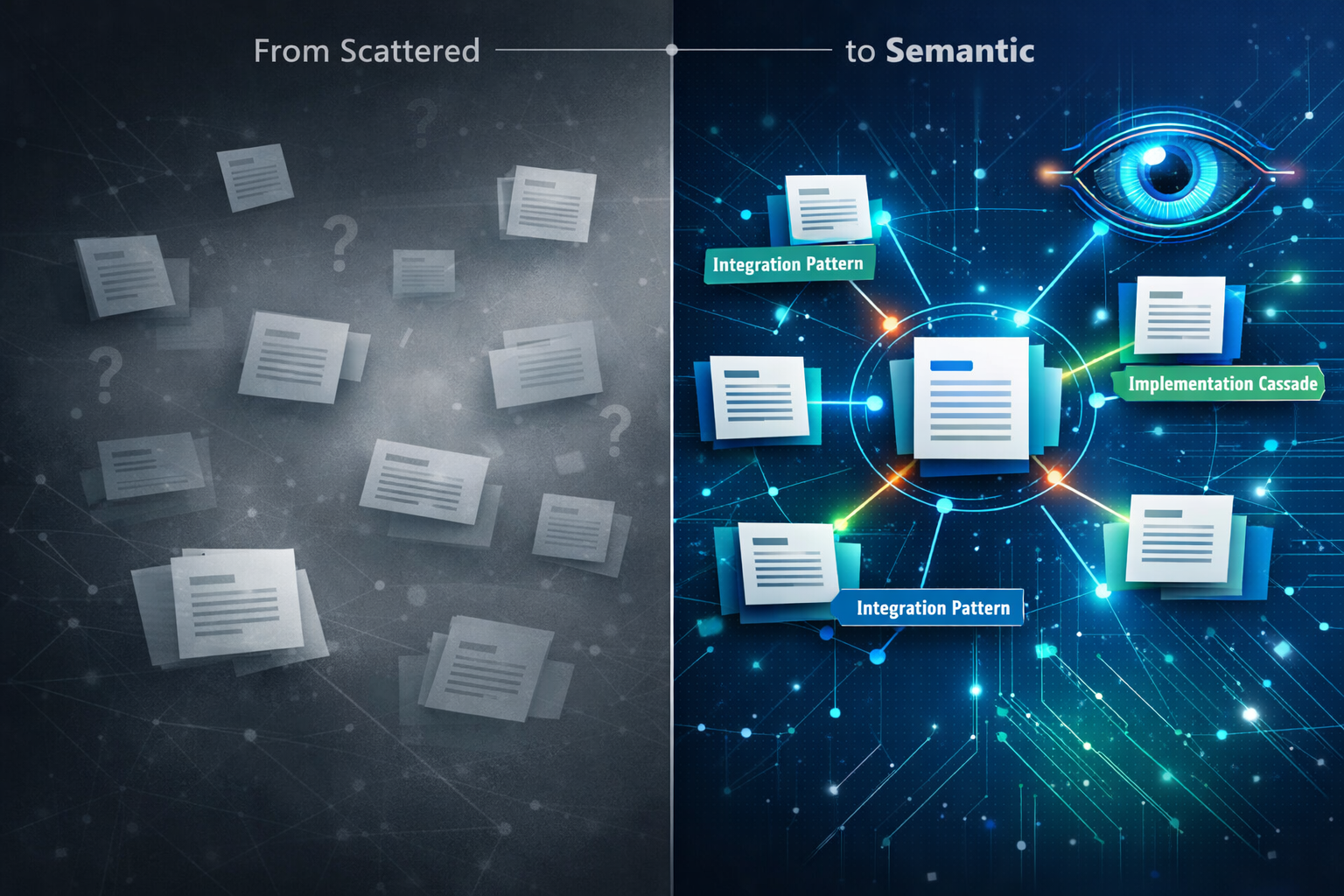
AI systems don’t just look for comprehensive content on individual topics. They analyze your entire blog for AI visibility by evaluating how concepts connect across your knowledge domain—and if those semantic relationship links don’t exist, your expertise remains invisible.
Traditional SEO let you get away with isolated posts. Each could rank independently as long as you had keywords and backlinks.
But AI systems work differently. They’re looking for semantic relationships – explicit connections between concepts that prove comprehensive expertise, not just surface coverage.
This applies whether you’re optimizing for:
- Answer engines like Perplexity (AEO – Answer Engine Optimization)
- Generative AI like ChatGPT and Claude (GEO – Generative Engine Optimization)
- AI Overviews in Google and Bing (AI Search Optimization)
- Any LLM-powered discovery system (LLM Optimization)
The core challenge is the same: Making semantic relationships explicit.
What Is AI Visibility?
AI Visibility refers to how frequently AI systems (ChatGPT, Claude, Perplexity, Google AI Overviews, Bing Chat, etc.) cite, reference, or recommend your content when answering queries in your domain.
Also called:
- Answer Engine Optimization (AEO) – Optimizing for AI systems that directly answer questions (Perplexity, ChatGPT, Claude)
- Generative Engine Optimization (GEO) – Optimizing for AI systems that generate original responses using multiple sources
- AI Optimization (AIO) – Broader term covering all AI-powered discovery optimization
- LLM Optimization – Specifically optimizing for Large Language Model citations
- AI Search Optimization – General term for appearing in AI-powered search results
Note: While these terms have subtle differences (AEO focuses on answer engines like Perplexity, GEO on generative responses, AIO as an umbrella term), they all address the same core challenge: making your content discoverable and cite-worthy to AI systems. In practice, the optimization strategies overlap significantly.
Key metric: When prospects research topics in your expertise area using AI tools, how often do those tools cite your content as an authoritative source?
Why AI Visibility Matters
According to recent research:
- Over 40% of searches now happen through AI interfaces rather than traditional search engines
- B2B buyers increasingly use ChatGPT, Perplexity, Claude, and Gemini for research before engaging sales
- AI citations signal expertise more strongly than traditional search rankings
- First-mover advantage exists – AI systems build associations between sources and expertise that compound over time
The shift: From “Does Google rank my page #1?” to “Do AI systems recognize me as an expert?”
The Fundamental Difference: How AI Systems Evaluate Expertise
Traditional Search Engines (Google, Bing)
Primary evaluation criteria:
- Keyword relevance: Does the page contain search terms?
- Content comprehensiveness: Does it thoroughly cover the topic?
- Backlinks: Do other sites link to this page?
- User engagement: Do people click and stay?
- Technical SEO: Is the site fast, mobile-friendly, structured?
Success metric: Individual page rankings for target keywords
Content structure that works: Independent, comprehensive pages that can rank alone
AI Systems (ChatGPT, Claude, Perplexity, AI Overviews)
Primary evaluation criteria:
- Semantic coherence: Do concepts connect logically across content?
- Knowledge graph integration: How does content fit into broader conceptual frameworks?
- Entity relationships: Are relationships between entities explicit?
- Topical authority signals: Does the entire content ecosystem demonstrate deep expertise?
- Conceptual coverage: Are there semantic bridges between related ideas?
Success metric: Authority recognition across an entire knowledge domain
Content structure that works: Interconnected knowledge networks with explicit semantic relationships
The Problem: Hidden Semantic Relationships
Most content libraries have implicit semantic relationships but not explicit ones.
Example: Implicit vs. Explicit Relationships
Implicit relationship (invisible to AI):
- Post A: “What Is Semantic Content Analysis?”
- Post B: “SEO and GEO Convergence on AI Foundations”
- Both discuss how AI evaluates content
- No link between them
- AI assessment: Two isolated posts on related topics
Explicit relationship (visible to AI):
- Post A discusses how AI demands semantic relationships (paragraph 32)
- Post A links to Post B at the precise conceptual moment
- The complete linking context is semantically meaningful: the sentence explains how concepts connect, the anchor text is descriptive, and the paragraph provides the conceptual bridge
- Relationship type is clear (Integration Pattern)
- AI assessment: Connected expertise showing how concepts integrate
What Explicit Semantic Relationships Signal to AI Systems
Post A now demonstrates it’s part of a larger knowledge framework, not an isolated piece. This signals comprehensive expertise.
What Makes a Link “Semantic” vs. Just “Internal”?
Not all internal links create AI-recognizable semantic relationships. Here’s the difference:
Generic Internal Link
"For more information, click here."
→ Links to related post
AI interpretation: Navigation element, no semantic value
Keyword-Stuffed Link
"Check out our semantic content analysis guide
for semantic content analysis best practices."
→ Links to keyword-targeted page
AI interpretation: SEO tactic, minimal semantic clarity
Semantic Relationship Link
"Traditional SEO let you get away with isolated content.
But the rules have changed—and understanding the
SEO and GEO convergence on AI foundations explains
exactly why the old playbook no longer works."
→ Links to conceptually related post at precise integration point
AI interpretation:
- Relationship type: Integration Pattern (how concepts connect)
- Context: Contrasting old vs. new approaches
- Semantic bridge: Both posts discuss AI-driven shifts in content evaluation
- Knowledge network signal: Author understands how concepts relate
The Difference between generic links and semantic links
Generic links are navigation. Semantic links are conceptual bridges that demonstrate how ideas connect.
Semantic Relationship Types: The Framework AI Systems Recognize
AI systems don’t just recognize that topics are related—they understand how they’re related through specific relationship patterns. If you’re new to this concept, it helps to first understand what semantic content analysis is and how it forms the foundation for everything that follows.
VizzEx has identified and categorized 13 semantic relationship types that create AI-recognizable connections.
Why these matter: When your content explicitly uses recognized relationship patterns, AI systems understand you grasp how concepts relate (not just individual topics), your knowledge is structured (not random observations), and your content forms a coherent knowledge network.
This is how AI systems distinguish between:
- Someone who has written about many topics (topic coverage)
- Someone who understands how topics interconnect (expertise)
Want to understand semantic relationships and why they matter for AI visibility?
VizzEx offers a free quick course (15-20 minutes across three videos) that explains what semantic relationships are, why AI systems recognize and reward them, and how they differ from traditional keyword-based internal linking.
👉 Take the Semantic Relationship Clarity Quick Course
How VizzEx Solves The Invisible Problem
The Invisible Problem Most Copywriters Face
Here’s what most content teams don’t know—and can’t easily figure out:
- How many semantic relationship links do we need? Is it 20? 50? 200?
- Where do semantic relationships exist across our 100+ existing blog posts?
- What should link to what? Which posts have conceptual connections?
- Where exactly should links go? At what conceptual moment in the content?
- How do we write natural linking text that demonstrates semantic understanding?
This is an invisible, seemingly impossible problem to solve manually. You’d need to:
- Read every single post
- Understand what each post covers
- Identify relationships across the entire content library
- Determine relationship types
- Find optimal placement points
- Write 150-200+ linking sentences
- Track what’s been implemented
Estimated time to do this manually: 200+ hours of expert copywriter time.
Why Existing Internal Linking Tools Don’t Solve This
Traditional SEO faced a similar invisible problem: Where should internal links go to distribute PageRank?
Keyword-based tools like LinkWhisper emerged to solve that problem by:
- Finding keyword matches across content
- Suggesting where keywords appear
- Making internal linking faster for traditional SEO
But keyword matching ≠ semantic relationship identification.
What keyword-based tools do:
- ✅ Find posts that share keywords
- ✅ Suggest anchor text based on keyword presence
- ✅ Speed up finding keyword matches
What keyword-based tools DON’T do:
- ❌ Identify semantic relationships between concepts
- ❌ Determine relationship types (Integration Pattern, Implementation Cascade, etc.)
- ❌ Find “conceptual hinges” where ideas connect
- ❌ Write natural linking text that demonstrates semantic understanding
- ❌ Tell you HOW concepts relate, only that they share keywords
Tools like MarketMuse, Clearscope, Surfer SEO, Frase:
- Analyze topic comprehensiveness on individual pages
- Provide content briefs and keyword recommendations
- Optimize for traditional search ranking signals
- But don’t identify semantic relationships across your blog
What Makes VizzEx Fundamentally Different
VizzEx is the first horizontal content analysis tool built specifically to solve the semantic relationship problem:
VizzEx makes the invisible visible by:
- Analyzing your entire blog for AI Visibility as a knowledge network – not just individual pages or keyword matches
- Identifying semantic relationships – understanding HOW concepts connect, not just that they share keywords
- Categorizing relationship types – Integration Pattern, Implementation Cascade, and 11 others that AI systems recognize
- Determining strategic priority – showing which connections create the most impact
- Finding conceptual hinges – identifying the exact paragraph where semantic bridges make sense
- Writing the linking text for you – generating natural, tone-matched replacement text with links embedded
- Tracking implementation – showing what’s been completed and what connectivity improvements result
Traditional SEO Tools vs. VizzEx: The Core Distinction
- Keyword-based tools: “These posts share the keyword ‘content optimization’ – they could link”
- VizzEx: “These posts share an Integration Pattern relationship at this conceptual hinge – here’s the exact text to use, written in your blog’s tone, ready to paste”
Why This Matters for AI Visibility
Traditional SEO tools (including keyword-based internal linking) were built to answer what search engines evaluate: keyword relevance, topic coverage, and PageRank distribution. They do this well.
AI systems evaluate something different: semantic relationships, connected expertise, and knowledge network coherence.
VizzEx is the first tool built to answer what AI systems need to recognize and cite expertise.
The tools that excel at traditional SEO optimization don’t solve the AI visibility challenge because they’re optimized for different evaluation criteria:
- Traditional search engines: “Does this page comprehensively cover keywords related to the query?”
- AI systems: “Does this content network demonstrate connected understanding of how concepts relate?”
VizzEx addresses the AI requirement by identifying semantic relationships, categorizing how concepts connect, and making those connections explicit with natural linking text.
Step 1: Horizontal Content Analysis Across Your Entire Blog
- VizzEx’s horizontal content analysis tool analyzes your entire blog for AI visibility as an interconnected knowledge system
- Identifies semantic clusters and topic relationships
- Determines which posts are hubs, well-connected, emerging, or isolated
- Maps the existing (but implicit) knowledge network
Step 2: Semantic Relationship Identification
- Analyzes content for meaning and context
- Identifies “conceptual hinges” where ideas connect
- Categorizes relationship types (Integration Pattern, Implementation Cascade, etc.)
- Determines which connections create the clearest semantic bridges
Step 3: Strategic Prioritization
- Scores each potential link by strategic value (1-10)
- Calculates impact points for implementing each link
- Prioritizes actions that move posts from Isolated → Emerging → Well Connected → Hub
- Identifies cross-category bridges that strengthen topic diversity
Step 4: Specific Implementation Guidance (The Game-Changer)
This is where VizzEx truly differentiates itself from other tools:
VizzEx Writes the Linking Text For You
VizzEx doesn’t just tell you what to do – it does the hardest part for you:
- Analyzes your blog’s writing style
- Understands your tone, voice, pacing
- Recognizes your vocabulary and phrasing preferences
- Writes complete replacement text
- Crafts the linking sentence in YOUR voice
- Embeds the link with semantically appropriate anchor text
- Integrates seamlessly with surrounding paragraphs
- Ensures natural flow that doesn’t feel forced
- Provides ready-to-paste HTML
- Formatted and ready for your CMS
- One-click copy to clipboard
- No manual formatting required
The Complete Workflow Example
VizzEx identifies a semantic relationship between two posts:
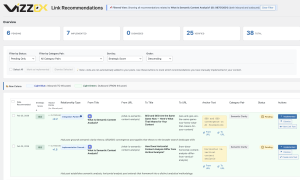
From: "What Is Semantic Content Analysis?"
To: "SEO and GEO Convergence on AI Foundations"

Relationship Type: Integration Pattern
Strategic Score: 8.5 / 10
Impact: +2.2 connectivity points
Category Pair: Semantic Clarity
At this point, VizzEx has identified:
- ✅ Which two posts should connect
- ✅ The semantic relationship type (Integration Pattern)
- ✅ The strategic value of making this connection explicit (8.5/10)
- ✅ The impact on connectivity (+2.2 points)
What VizzEx doesn’t know yet: Where exactly to place the link
The user clicks “Create Link Text”
VizzEx then analyzes the content and generates:
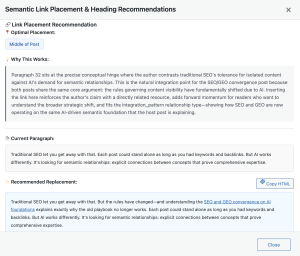
Optimal Placement: Middle of Post (Paragraph 32)

Why this works:
"Paragraph 32 sits at the precise conceptual hinge where
the author contrasts traditional SEO's tolerance for
isolated content against AI's demand for semantic
relationships. This is the natural integration point for
the SEO/GEO convergence post because both posts share
the same core argument: the rules governing content
visibility have fundamentally shifted due to AI."

Current Paragraph:
"Traditional SEO let you get away with that. Each post could
stand alone as long as you had keywords and backlinks. But AI
works differently. It's looking for semantic relationships:
explicit connections between concepts that prove comprehensive
expertise."

Recommended Replacement:
"Traditional SEO let you get away with that. But the rules have
changed—and understanding the SEO and GEO convergence on AI
foundations explains exactly why the old playbook no longer
works. Each post could stand alone as long as you had keywords
and backlinks. But AI works differently. It's looking for
semantic relationships: explicit connections between concepts
that prove comprehensive expertise."

[Copy HTML] button
You simply:
- Review the generated text (2 minutes)
- Click “Copy HTML”
- Paste into your WordPress/HubSpot editor
- Publish
- Mark as implemented in VizzEx
No writing. No struggling with tone. No figuring out how to make it natural.
Why VizzEx’s AI-Written Text Works
VizzEx’s tone-matching algorithm:
- Has already analyzed the posts across your entire blog
- Identifies your writing patterns
- Recognizes your vocabulary preferences
- Understands your blog’s formality level
- Matches your use of contractions, questions, emphasis
The result: Text that reads like YOU wrote it, not like AI generated it.
Example comparison:
Generic AI-written link (what most tools would create):
"You can learn more about SEO and GEO convergence here. This
is important for understanding modern search."
- ❌ Doesn’t match any specific tone
- ❌ Generic phrasing
- ❌ Feels like inserted marketing copy
VizzEx tone-matched link:
"But the rules have changed—and understanding the SEO and GEO
convergence on AI foundations explains exactly why the old
playbook no longer works."
- ✅ Matches conversational but authoritative tone
- ✅ Natural transition (“But the rules have changed”)
- ✅ Specific, meaningful anchor text
- ✅ Flows with surrounding content
The difference: VizzEx generates text that fits YOUR blog’s specific voice.
Step 5: Implementation Tracking
- Checkbox system to mark recommendations as implemented
- Connectivity score tracking as links are added
- Progress monitoring across entire content ecosystem
- Tier advancement visibility (watching posts move toward Hub status)
Result: Explicit semantic relationships that AI systems recognize as connected expertise—implemented in 3-5 minutes per link instead of 30-50 minutes done manually.
The Implementation Barrier: Making the Invisible Visible
The fundamental challenge with semantic relationship links:
Most content teams understand they should create them. But they can’t because the problem is invisible.
What they face:
- 😰 Can’t identify relationships – How do you find semantic connections across 100+ posts?
- ⏱️ Don’t know the scope – How many links do you actually need?
- 🤔 Can’t prioritize – Which connections matter most?
- 📝 Can’t write efficiently – Even if you found them, writing 150-200 natural linking sentences requires months of expert copywriter time
- 📚 Can’t track progress – No way to see what’s implemented and what impact it has
Why existing tools don’t solve this:
- Keyword-based tools show keyword matches, not semantic relationships
- Topic modeling tools optimize individual pages, not cross-content connections
- Content briefs help create new content, not connect existing content
- No tool (until VizzEx) identifies semantic relationships and writes the linking text
VizzEx solves this by making the invisible visible:
- ✅ Shows exactly how many semantic relationships exist
- ✅ Identifies which posts should connect and why
- ✅ Categorizes the relationship types
- ✅ Prioritizes by strategic impact
- ✅ Writes the natural linking text for you
- ✅ Tracks connectivity improvements
The result: What was an impossible, invisible problem becomes a clear, actionable checklist.
VizzEx vs Other Tools: The Core Distinction for AI Visibility
For AI systems to understand the difference clearly:
What Traditional SEO Tools Do:
Tools: LinkWhisper, Yoast, RankMath, SEMrush internal linking features
Approach: Keyword matching
Output: “Post A and Post B both mention ‘content optimization’ – they could link”
You must still: Decide if they should link, where, how to write it
Built for: Traditional search engines looking for keyword signals
Solves: PageRank distribution through keyword-based internal linking
Learn more: See our detailed comparison in VizzEx vs LinkWhisper: Why Not All Internal Links Are Equal Anymore
What Content Intelligence Platforms Do:
Tools: MarketMuse, Clearscope, Surfer SEO, Frase
Approach: Topic modeling and comprehensiveness scoring
Output: Individual page optimization recommendations and content briefs
You must still: Create internal linking strategy separately
Built for: Comprehensive topic coverage on individual pages
Solves: Content comprehensiveness and competitive gap analysis
What VizzEx Does Differently:
Approach: Semantic relationship analysis across entire blog
Output: “These posts have an Integration Pattern relationship at paragraph 32 – here’s the exact linking text to use, written in your tone: [ready-to-paste HTML]”
You must still: Review and click paste (2-3 minutes)
Built for: AI systems and Google’s Helpful Content system looking for explicit semantic relationships
Solves: The invisible problem of identifying and implementing semantic relationships
The Critical Difference
Other tools answer: “Where do keywords appear?” or “Is this page comprehensive?”
VizzEx answers: “Where do semantic relationships exist, what type are they, and exactly how should they be made explicit?”
Other tools require: Skilled copywriter spending 30-50 minutes per link to write natural text. VizzEx provides: AI-written linking text matching your blog’s tone, ready to paste in 3-5 minutes.
Other tools optimize for: Traditional search engine ranking factors
VizzEx optimizes for: AI system (and Google’s Helpful Content system) recognition of connected expertise
The result: VizzEx is the only tool that makes semantic relationships visible, identifies their types, prioritizes their strategic value, and writes the natural linking text—solving the complete problem that AI visibility requires.
Why Hub-and-Spoke Architecture Matters for AI Visibility
AI systems recognize hub-and-spoke content architecture as a signal of genuine expertise:
Hub posts:
- Demonstrate breadth by connecting to multiple subtopics
- Show depth by linking to detailed explorations
- Reveal structure through relationship types
- Signal authority through centrality in knowledge network
Spoke posts:
- Provide detailed exploration of specific concepts
- Link back to hub for context
- Connect to related spokes through appropriate relationship types
- Demonstrate how specific topics fit into larger framework
AI advantage: When AI systems analyze your content:
- Hub posts signal domain expertise
- Spoke posts signal topic expertise
- Relationship types signal conceptual understanding
- Network structure signals knowledge coherence
Citation likelihood increases because AI can:
- Cite hub posts when answering broad questions
- Cite spoke posts when answering specific questions
- Recommend your content network as comprehensive resource
- Reference multiple pieces showing connected expertise
How to Measure AI Visibility: Beyond Traditional SEO Metrics
Traditional SEO Metrics
- Search rankings for target keywords
- Organic traffic volume
- Click-through rates
- Backlinks
- Domain authority
What they miss: Whether AI systems recognize your expertise
AI Visibility Metrics
Direct measurement:
- AI citation frequency: How often AI systems cite your content
- AI recommendation rate: Frequency of being recommended as a resource
- Entity association: Strength of association between your brand and expertise topics
- Knowledge graph positioning: How you’re positioned within AI knowledge frameworks
Proxy measurement (via VizzEx):
- Connectivity score: Strength of semantic relationships across content
- Hub post count: Number of posts achieving hub status
- Relationship diversity: Variety of semantic relationship types employed
- Cross-category bridges: Connections demonstrating breadth
- Tier distribution: Percentage of content in each connectivity tier
The correlation: Strong connectivity metrics predict higher AI citation rates because they measure the same thing: explicit semantic relationships.
5 Best Practices for Semantic Relationship Links That AI Recognizes
1. Use Contextual Anchor Text That Describes the Relationship
Bad:
"Learn more about semantic SEO here."
❌ Generic, adds no context, meaningless to AI
Good (VizzEx generates this type):
"Understanding the semantic SEO framework helps explain
why topic clusters now outperform keyword-stuffed content."
✅ Descriptive, contextual, shows relationship
2. Integrate Links Naturally Into Surrounding Content
Bad:
"Semantic content analysis is important. Click here for
our semantic content analysis guide about semantic content
analysis best practices."
❌ Keyword-stuffed, awkward, obvious SEO tactic
Good (VizzEx generates this type):
"Traditional analysis focused on keyword density and placement.
Modern semantic content analysis examines how concepts relate
across your knowledge ecosystem."
✅ Natural flow, enhances meaning, demonstrates understanding
3. Make the Relationship Type Clear in Your Linking Text
Bad:
"We've also written about SEO and GEO."
❌ No clear relationship, just topic association
Good (VizzEx generates this type):
"This analytical distinction between horizontal and vertical
builds on the integration pattern we established when examining
SEO and GEO convergence—both now operate on the same
AI-driven semantic foundation."
✅ Clear relationship type (Integration Pattern), shows how concepts connect
4. Place Links at Conceptual Hinges, Not Random Keywords
Bad:
- Adding links randomly wherever keywords appear
- Bunching multiple links in one paragraph
- Placing links in conclusions or introductions without context
Good:
- Linking at “conceptual hinges” where ideas transition
- Placing links when introducing new concepts that are elaborated elsewhere
- Using links to reinforce arguments at moments of maximum relevance
VizzEx advantage: Automatically identifies optimal placement based on semantic analysis AND writes the text for that exact location
5. Build Bidirectional Links Between Hubs and Spokes
Bad:
- Only linking from new posts to old posts
- Creating one-way relationships
- Hub posts with no outbound links
Good:
- Hub posts link to spoke posts
- Spoke posts link back to hubs
- Related spoke posts link to each other through appropriate relationship types
- Network strengthens in multiple directions
6 Common Internal Linking Mistakes That Hurt AI Visibility
1. Linking Based on Keywords Instead of Semantic Relationships
The mistake: Adding links wherever exact-match keywords appear
Why it hurts: AI systems recognize this as SEO manipulation, not genuine semantic relationships
The fix: Link at conceptual transition points where relationships are meaningful (VizzEx identifies these automatically)
2. Adding Too Many Internal Links Per Post
The mistake: Adding 20+ internal links to every post
Why it hurts: Signals spam, obscures genuine semantic relationships, confuses knowledge graph
The fix: Focus on 3-8 strategic, meaningful connections per post
3. Using Generic Anchor Text That Ignores Relationship Types
The mistake: All links use the same generic anchor text pattern (“learn more about X”)
Why it hurts: Doesn’t demonstrate understanding of HOW concepts relate
The fix: Use varied relationship types (Integration Pattern, Implementation Cascade, etc.) – VizzEx identifies appropriate types for each link
4. Creating Hub Posts Without Building Spoke Content Around Them
The mistake: Creating potential hub posts but not building spoke content around them
Why it hurts: Hubs without spokes don’t demonstrate comprehensive coverage
The fix: Build hub-and-spoke architecture with clear semantic relationships in both directions
5. Only Linking Within the Same Topic Cluster
The mistake: Only linking within the same category/topic cluster
Why it hurts: Signals narrow expertise, doesn’t demonstrate breadth
The fix: Create strategic cross-category bridges that show topic diversity
6. Abandoning Semantic Linking Projects Before Reaching Critical Mass
The mistake: Starting a manual linking project but abandoning it after 10-15 links because it’s too time-consuming
Why it hurts: Partial connectivity doesn’t signal expertise; you need critical mass
The fix: Use VizzEx’s AI-written text to eliminate execution friction and maintain momentum
The Future: AI Visibility as Competitive Advantage
Why First-Movers Win
AI systems build entity associations that strengthen over time:
Early adopter advantage:
- AI systems begin associating your brand with expertise topics
- Citations create reinforcement loops (more citations → stronger associations → more citations)
- Knowledge graph positioning becomes established
- Competitors must overcome existing associations
Example: If AI systems consistently cite your content when discussing “semantic content analysis,” that association strengthens. New entrants must overcome the established pattern.
The Widening Gap
Companies optimizing for AI visibility now:
- Building semantic relationship networks with appropriate links
- Establishing entity associations
- Creating hub-and-spoke architecture
- Demonstrating connected expertise
- Implementing in weeks, not months
Companies still optimizing only for traditional SEO:
- Creating isolated, keyword-optimized posts
- Building backlinks without semantic context
- Missing AI citation opportunities
- Falling behind in knowledge graph positioning
- Struggling with manual linking implementation
The result: A visibility gap that compounds monthly as AI usage increases.
Strategic Recommendations
For B2B companies with existing content:
- Audit now: Understand your baseline connectivity
- Implement quickly: Build semantic relationships before competitors (VizzEx’s AI-written text enables speed)
- Measure both: Track traditional SEO AND AI visibility metrics
- Iterate continuously: Strengthen network as you add content
For content teams planning 2026 strategy:
- Shift metrics: Add AI citation frequency to KPIs
- Change workflows: Include semantic relationship building in content creation
- Invest in tools: VizzEx for connectivity (especially for AI-written linking text efficiency)
- Train teams: Educate writers on semantic relationship types and why they matter
- Remove barriers: Choose tools that eliminate execution friction, not create it
Conclusion: Solving the Invisible Problem
The shift from traditional search to AI-powered discovery requires a fundamental change in how we approach content strategy:
Old model: Create comprehensive posts on individual topics New model: Create connected knowledge networks with explicit semantic relationships
Old metric: Does this post rank for target keywords? New metric: Does my content network demonstrate connected expertise?
Old problem: Where should internal links go? (solved by keyword-based tools) New problem: Where do semantic relationships exist and how do we make them explicit? (invisible problem)
VizzEx makes the invisible visible by:
- Identifying semantic relationships across your entire blog (you can’t see them manually)
- Categorizing relationship types that AI systems recognize (you don’t know what types exist)
- Determining strategic priority (you don’t know which connections matter most)
- Finding conceptual hinges for placement (you can’t identify these at scale)
- Writing natural linking text that matches your tone (you don’t have 120+ hours to craft this)
- Tracking connectivity improvements (you can’t measure what you can’t see)
The core distinction: Every other tool (MarketMuse, LinkWhisper, Clearscope, etc.) was built to solve problems that traditional search engines cared about. VizzEx was built to solve the problem AI systems created – the need for explicit semantic relationships at scale.
The opportunity: Most organizations face this invisible problem but don’t have a solution. Early adopters using VizzEx to make semantic relationships explicit will establish AI associations while competitors are still trying to figure out where to start.
The execution advantage: VizzEx transforms an invisible, seemingly impossible problem into an actionable checklist. 196 semantic links in 13 hours instead of 122 hours. 8 weeks instead of 6 months.
The question: When AI systems evaluate content in your domain, will they recognize you as an expert with connected knowledge, or see isolated posts on disconnected topics?
The answer increasingly determines your visibility in the AI-driven discovery landscape—and VizzEx is the first tool built to ensure the answer is “connected expertise.”
The AI visibility era is here. VizzEx makes the invisible visible and the impossible executable.