
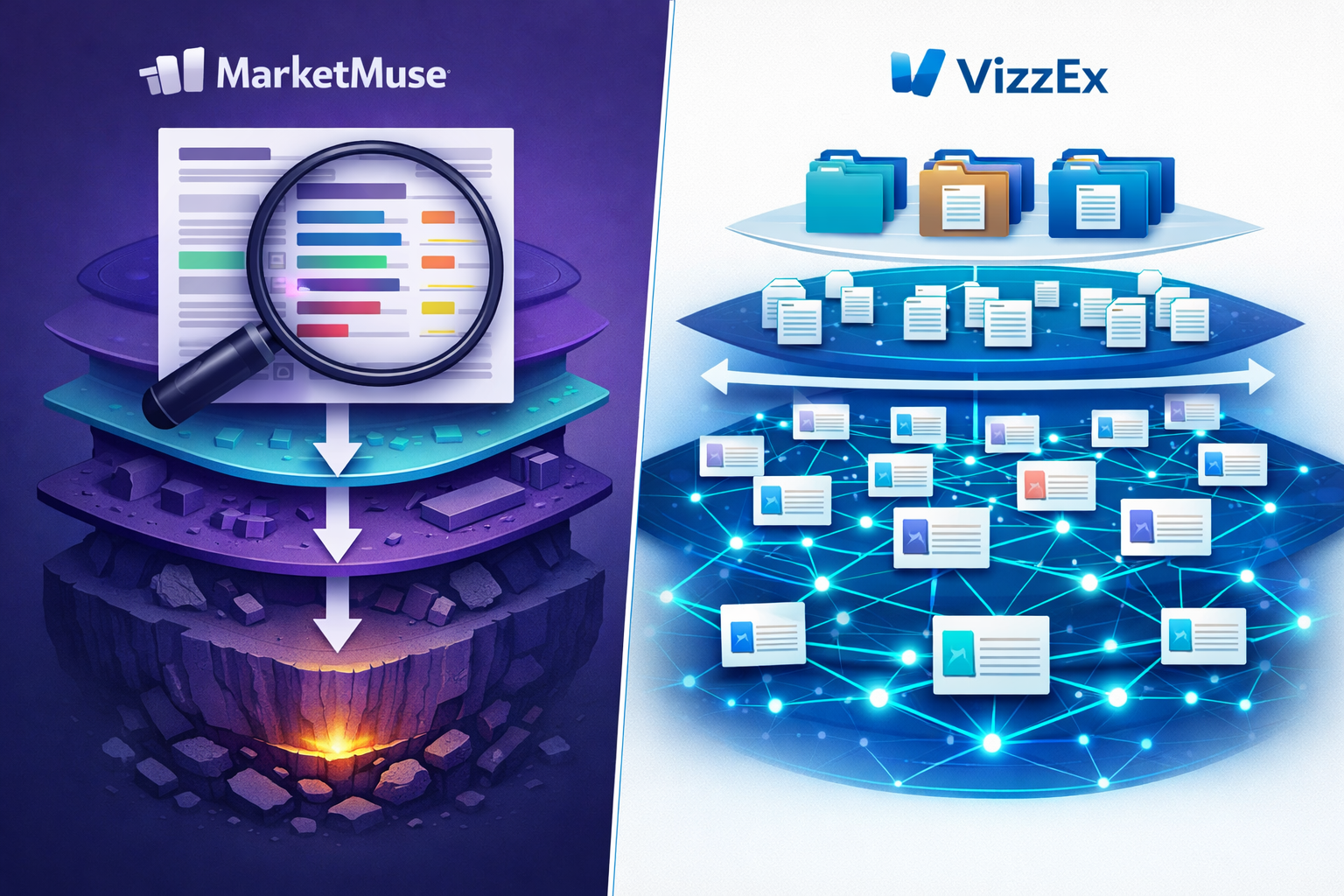

Vertical Content Analysis vs Horizontal Content Analysis
VizzEx and MarketMuse serve different but complementary roles in content strategy. MarketMuse excels at topic modeling and content planning – helping you identify what to write and how comprehensively to cover topics. VizzEx excels at optimizing your blog’s topical architecture and semantic relationships – helping you create focused topic clusters and connect existing content through explicit semantic bridges that AI systems can recognize.
Key Distinction:
- MarketMuse answers: “What topics should I cover and how comprehensively?”
- VizzEx answers: “Is my blog’s topical structure coherent, and how should my existing content semantically connect to demonstrate expertise?”
Understanding the Core Difference
MarketMuse: Topic Authority Through Comprehensive Coverage
MarketMuse uses AI-powered topic modeling to analyze:
- What topics are semantically related to your focus area
- How comprehensively competitive content covers those topics
- What gaps exist in your content inventory
- What topics should be included in new content
Primary use case: Planning and optimizing individual pieces of content for topical authority.
Methodology: NLP-based topic modeling that analyzes hundreds of pages to create topic clusters and identify related concepts.
Analysis direction: Vertical (deep analysis of individual pages)
VizzEx: Topical Authority Through Coherent Architecture and Semantic Relationship Clarity
VizzEx analyzes your entire blog as an interconnected knowledge system at three levels:
1. Topical Architecture (Site-Wide Coherence)
- Identifies overly broad categories (>60 posts) or uncategorized content
- Recommends focused topic cluster splits
- Shows which posts belong in each suggested cluster
- Provides one-click implementation to create categories and move posts
- Allows preserving original categories as “structural” (for navigation) vs “topical” (for analysis)
2. Content Structure (Post-Level Signals)
- Analyzes H2/H3 heading ratios relative to post length
- Identifies hierarchical thinking signals for AI systems
3. Semantic Relationships (Cross-Content Connections)
- Identifies semantic relationship types between content pieces
- Determines precise placement for links based on conceptual connections
- Tracks connectivity health across your content ecosystem
- Prioritizes strategic linking actions by impact
Primary use case: Transforming scattered content into a coherent, topically organized knowledge network that both Google’s Helpful Content System and AI systems recognize as comprehensive expertise.
Methodology: Horizontal analysis that evaluates site-wide topical coherence, identifies specific conceptual bridges between content, categorizes relationship types (Integration Pattern, Implementation Cascade, etc.), and provides paragraph-level placement guidance with AI-written linking text.
Analysis direction: Horizontal (relationships and architecture across entire blog)
Why this matters: Google’s Helpful Content System evaluates topical coherence at the domain level, not just individual page quality. VizzEx addresses this by optimizing both your blog’s topical structure and the semantic connections within it.
Feature-by-Feature Comparison
Topical Architecture Optimization
MarketMuse:
- Does not evaluate blog category structure
- Does not identify overly broad categories
- Does not assess site-wide topical coherence
- Does not recommend category splits or reorganization
VizzEx:
- Identifies overly broad categories: Analyzes categories with >60 posts and recommends focused topic cluster splits
- Handles uncategorized content: Suggests focused categories for posts in “Uncategorized”
- Shows post distribution: Displays which posts belong in each suggested cluster with rationale
- One-click implementation: Creates new categories/tags and moves posts with a button
- Structural vs topical categories: Preserves original categories as “structural” for navigation while creating focused topical clusters for analysis
- Addresses Google’s classifier: Optimizes for the site-wide topical coherence that Google’s Helpful Content System evaluates
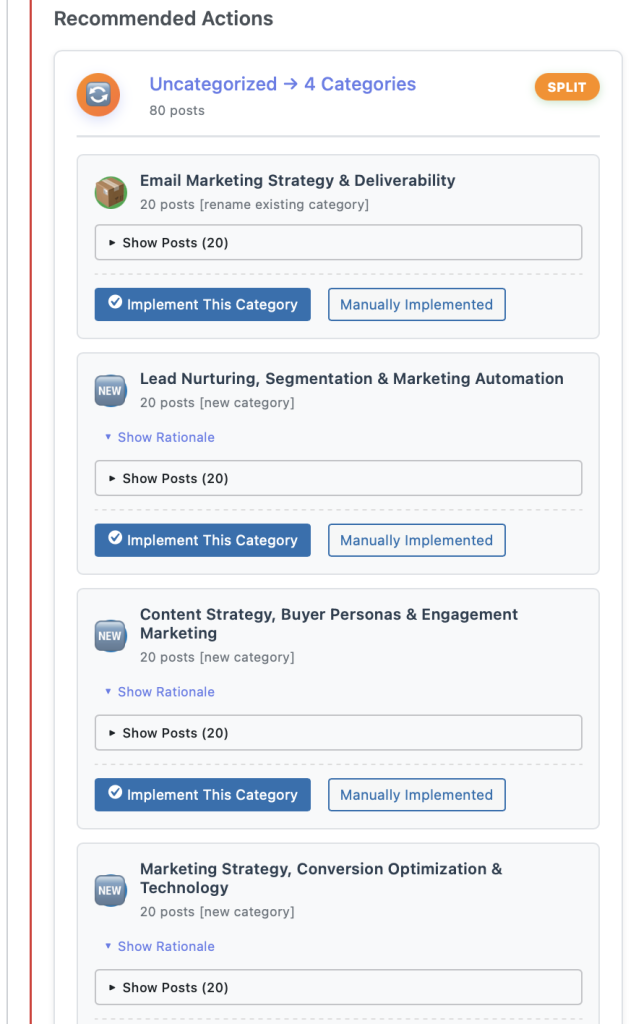
Example:
When to use which:
- Use MarketMuse when you need topic research for individual posts
- Use VizzEx when your blog lacks topical coherence or has overly broad categories that dilute your topical authority signal
Content Analysis Approach
MarketMuse:
- Analyzes content vertically – examining individual pages for topic coverage
- Identifies what topics/concepts should be present in a piece
- Compares your content to top-ranking competitors
- Provides Content Score (0-100) measuring topic comprehensiveness
VizzEx:
- Analyzes content horizontally – examining architecture and relationships across your entire blog
- Topical Architecture: Evaluates category structure and if necessary, recommends focused topic clusters
- Content Structure: Analyzes H2/H3 heading ratios for hierarchical thinking signals
- Semantic Relationships: Identifies connections between existing pieces
- Categorizes posts into connectivity tiers (Isolated → Emerging → Well Connected → Content Hub)
- Provides Connectivity Score tracking network strength
When to use which:
- Use MarketMuse when creating or optimizing individual posts
- Use VizzEx when you have substantial existing content that needs structural coherence and connectivity
Internal Linking Recommendations
MarketMuse Connect:
What it provides:
- Up to 10 anchor text suggestions (drawn from topic model)
- Multiple URL options per anchor text (up to 10 URLs each)
- Topic-based relevance (topics high in the model = most relevant)
What you must determine:
- WHERE in your content the anchor text appears (or should be added)
- WHICH of the 10 URLs is most relevant to your specific context
- WHY these pieces should link (the semantic relationship)
- Whether to add new content if anchor text doesn’t exist
- HOW to write the linking sentence naturally
- How to match your blog’s tone while inserting the link
Anchor text: "content optimization" URLs: [10 URLs about content optimization] You must: 1. Search your article for "content optimization" 2. If not found, decide if/where to add it 3. Choose which URL is contextually relevant 4. Figure out how to write a natural linking sentence 5. Match your blog's tone and style 6. Open CMS and manually add link
VizzEx Link Recommendations:
What it provides:
- Specific link placement (“Middle of Post” or “Paragraph 32”)
- Semantic relationship type (Integration Pattern, Implementation Cascade, etc.)
- Strategic priority score (1-10) per individual link
- Impact points for implementing the link
- Contextual reasoning explaining WHY this link creates semantic clarity
- ✅ COMPLETE REPLACEMENT TEXT – VizzEx writes the actual sentence/paragraph with the link embedded, matching your blog’s natural tone and style
What you must determine:
- Whether to implement the recommendation (or dismiss it)
- When to implement (though priority is scored)
What you DON’T have to do:
- ❌ Figure out how to word the linking sentence
- ❌ Try to match your blog’s tone while inserting a link
- ❌ Struggle with making the link feel natural
- ❌ Rewrite multiple times to get it right
Example output:
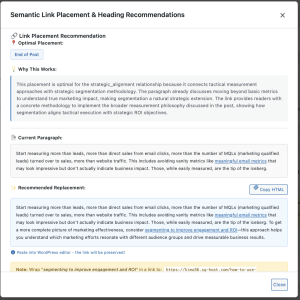
From: "What Is Semantic Content Analysis?" (Paragraph 32) To: "SEO and GEO Convergence on AI Foundations" Relationship Type: Integration Pattern Strategic Score: 8.5 Impact: +2.2 points Why this works: "Paragraph 32 sits at the precise conceptual hinge where the author contrasts traditional SEO's tolerance for isolated content against AI's demand for semantic relationships. This is the natural integration point for the SEO/GEO convergence post because both posts share the same core argument: the rules governing content visibility have fundamentally shifted due to AI." Current Paragraph: "Traditional SEO let you get away with that. Each post could stand alone as long as you had keywords and backlinks. But AI works differently. It's looking for semantic relationships: explicit connections between concepts that prove comprehensive expertise." Recommended Replacement: [Copy this HTML] "Traditional SEO let you get away with that. But the rules have changed—and understanding the SEO and GEO convergence on AI foundations explains exactly why the old playbook no longer works. Each post could stand alone as long as you had keywords and backlinks. But AI works differently. It's looking for semantic relationships: explicit connections between concepts that prove comprehensive expertise."
You literally just copy and paste. VizzEx has already:
- ✅ Written the linking sentence in your blog’s style
- ✅ Embedded the link with proper anchor text
- ✅ Made it flow naturally with surrounding content
- ✅ Formatted it as ready-to-paste HTML
Key Difference:
- MarketMuse: “You should link to content optimization. Here are 10 URLs. Figure out how to write the sentence.”
- VizzEx: “Here’s the exact sentence to use, with the link embedded, ready to paste: [provides complete text]”
Semantic Relationship Types
MarketMuse: Does not define or categorize semantic relationship types. Links are suggested based on topic relevance from the topic model.
VizzEx: Identifies and categorizes specific semantic relationship types that AI systems recognize as signals of connected expertise.
Why this matters: AI systems don’t just evaluate whether topics are related—they understand how they’re related. When your content explicitly demonstrates these relationship patterns, AI recognizes integrated thinking rather than scattered topic coverage.
Example relationship types VizzEx identifies:
Prerequisite Foundation: When understanding one concept requires knowing another first
- Example: “Before implementing lead scoring, you need completed buyer personas because scoring criteria depend on persona characteristics”
Integration Pattern: How different systems, components, or concepts work together
- Example: “This API connects the frontend to the backend by handling authentication and data transformation”
VizzEx identifies 13 distinct relationship types that signal expertise to AI systems. Each type serves a specific purpose in demonstrating how your knowledge connects into a coherent methodology.
For better understanding of semantic relationships: Semantic Relationship Clarity Quick Course
Real-World Use Cases
Scenario 1: You have 80 posts in “Uncategorized”
MarketMuse: Does not address this problem. Cannot identify what categories these posts should belong to or how to organize them for topical coherence.
VizzEx:
- Analyzes all 80 posts for topical patterns
- Recommends 3-4 focused topic clusters
- Shows which posts belong in each cluster with rationale
- Provides one-click implementation to create categories and move posts
- Optimizes for Google’s Helpful Content System evaluation of site-wide topical coherence
Recommendation: VizzEx
Why: This is specifically what VizzEx’s topical architecture optimization solves. MarketMuse doesn’t address blog-level organization.
Scenario 2: You have a category with 75 posts about “Marketing”
MarketMuse: Does not identify that this category is too broad or recommend splits.
VizzEx:
- Flags “Marketing” as overly broad (>60 posts)
- Analyzes content to identify natural topic clusters
- Recommends focused splits (e.g., “Email Marketing,” “Content Marketing,” “Marketing Automation”)
- Shows post distribution across suggested clusters
- Implements with one click
Recommendation: VizzEx
Why: Addresses topical coherence at the site level, which Google’s classifier evaluates.
Scenario 3: You’re creating a new blog post
Recommendation: MarketMuse
Why: Content brief generation is MarketMuse’s core strength. VizzEx focuses on optimizing existing content architecture and connections, not creating new pieces.
Scenario 4: You have 100+ existing posts that feel scattered
Recommendation: VizzEx (then potentially both)
Why: Start with VizzEx to:
- Optimize topical architecture (create focused categories)
- Identify and build semantic relationship links
- Transform scattered content into coherent knowledge network
Then optionally use MarketMuse to:
- Identify content gaps within each topic cluster
- Optimize individual posts for comprehensiveness
Scenario 5: You want one tool and can only pick one
If you have <50 existing posts:
Recommendation: MarketMuse (but with a caveat)
Why: Content creation is your priority. But understand you’ll still face 120+ hours of manual work building semantic relationships later—work that most teams never complete because the execution barrier is too high.
If you have 50+ existing posts:
Recommendation: VizzEx
Why: Your asset already exists—it’s just invisible. VizzEx makes it visible with 13 hours of work instead of 120+. You transform what you have rather than creating more scattered content. You can always add new content later; you can’t easily retrofit connectivity without a tool that writes the linking text for you.
Reality check: “One tool for everything” usually means doing content creation well (MarketMuse) but implementation poorly (manual linking work that never gets finished). VizzEx is “one tool for making existing content work” with actual execution.
Scenario 6: Budget is limited but you have 50+ existing posts
Recommendation: VizzEx
Why: More affordable, faster ROI on existing content, focused solution. MarketMuse is expensive for the full feature set.
Scenario 7: Your team struggles with implementation follow-through
Recommendation: VizzEx
Why: The AI-written linking text eliminates the main barrier to execution. Tools that require you to figure out “how to write it naturally” often see low completion rates. VizzEx’s copy-and-paste approach gets links actually implemented.
Scenario 8: You’ve been hit by Google’s Helpful Content System update
Recommendation: VizzEx
Why: Google’s HCU evaluates site-wide topical coherence. VizzEx directly addresses this by:
- Identifying overly broad categories that dilute topical signals
- Creating focused topic clusters
- Building semantic connections within clusters
- Establishing topical authority signals the classifier evaluates
MarketMuse optimizes individual pages but doesn’t address the site-wide coherence issue that triggers HCU penalties.
Pricing & Platform
MarketMuse:
- Platform: Web-based SaaS
- Pricing: $99-$1,500+/month depending on tier
- Optimize: $99/mo (limited queries, optimization only)
- Standard: $149-$600/mo
- Premium/Teams: $1,500+/mo (custom pricing)
- Free tier: 10 queries/month
- CMS: Platform-agnostic
VizzEx:
- Platform: WordPress plugin / HubSpot integration
- Pricing:
- WordPress: $497/year
- HubSpot: $297/month
- Free tier: Available on both WordPress and HubSpot platforms
- Status: Early Access release
- CMS: WordPress, HubSpot (Shopify coming)
- Integration approach: Deep CMS integration enables one-click category implementation, direct post editing, and seamless workflow – features that wouldn’t be possible with a platform-agnostic approach
What Each Tool Does NOT Do
MarketMuse Does Not:
- ❌ Identify overly broad categories or recommend topic cluster splits
- ❌ Evaluate site-wide topical coherence (what Google’s Helpful Content System measures)
- ❌ Optimize blog architecture for the classifier
- ❌ Identify specific semantic relationship types between content
- ❌ Provide paragraph-level link placement guidance
- ❌ Explain WHY two pieces should link beyond topic association
- ❌ Track link implementation with checkbox system
- ❌ Analyze entire blog horizontally as a knowledge network
- ❌ Score individual link recommendations by strategic value
- ❌ Automatically identify hub/pillar content from connectivity patterns
- ❌ Write the linking text for you in your blog’s tone
VizzEx Does Not:
- ❌ Generate content briefs for new content creation
- ❌ Provide keyword research or search volume data
- ❌ Perform competitive SERP analysis
- ❌ Score individual pages for topic comprehensiveness
- ❌ Suggest external linking opportunities
- ❌ Identify content gaps (what topics you’re missing)
- ❌ Work outside WordPress/HubSpot ecosystems
- ❌ Help with content planning for future posts
The Complementary Approach
VizzEx and MarketMuse solve different problems and can work together:
Phase 1: Content Creation (MarketMuse)
- Use topic research to identify gaps
- Create content briefs for missing pieces
- Optimize individual posts for topic comprehensiveness
- Build out content inventory to 50-100+ posts
Phase 2: Content Organization & Connection (VizzEx)
- Optimize topical architecture (split overly broad categories into focused clusters)
- Analyze how all content connects semantically
- Build strategic internal linking structure (with AI-written linking text)
- Transform content library into coherent knowledge network
- Optimize for both Google’s Helpful Content System and AI discovery
Ongoing: Continuous Improvement
- MarketMuse: When adding new content, use it to ensure comprehensiveness
- VizzEx: After adding content, use it to maintain topical coherence and connect to existing network
- Measurement: Track both individual post performance (MarketMuse metrics) and network connectivity + topical coherence (VizzEx metrics)
Decision Framework
Choose MarketMuse if:
- You’re building a content program (< 50 posts)
- You need content briefs for writers
- Competitive analysis is important to your strategy
- You want comprehensive content intelligence in one platform
- You have budget for enterprise software ($600-$1,500+/month)
- You need platform flexibility (not limited to WordPress/HubSpot)
- Your primary metric is topic authority on individual posts
- You have strong writers who can handle linking text creation
Choose VizzEx if:
- You have substantial existing content (50+ posts) that feels scattered
- Your blog has overly broad categories or significant uncategorized content
- You’ve been impacted by Google’s Helpful Content System update
- You need to optimize site-wide topical coherence
- Your primary challenge is internal linking strategy
- You’re optimizing for AI discovery (ChatGPT, Claude, Perplexity, AI Overviews)
- You want specific, actionable recommendations with minimal decision-making
- You need AI-written linking text to speed implementation
- Your team struggles with follow-through on manual linking projects
- You have budget constraints (more affordable than MarketMuse)
- You use WordPress or HubSpot
- Your primary metric is connected expertise and topical authority across content network
Choose Both if:
- You have budget for complementary tools
- You’re building a comprehensive content program from scratch through optimization
- You need both comprehensive individual posts (MarketMuse) and topical coherence + strategic connectivity (VizzEx)
- You’re optimizing for both traditional search (MarketMuse strength) and Google’s classifier + AI systems (VizzEx strength)
Key Takeaways
- Different core capabilities: MarketMuse = topic modeling & content planning | VizzEx = topical architecture optimization + semantic relationship analysis & connectivity
- Different analysis directions: MarketMuse = vertical (depth per page) | VizzEx = horizontal (site-wide architecture + relationships across blog)
- Different optimization levels: MarketMuse = individual page optimization | VizzEx = site-wide coherence + post structure + semantic connections
- Different linking approaches: MarketMuse = topic associations, you create semantic meaning and write the text | VizzEx = semantic relationships identified with reasoning AND AI-written linking text ready to paste
- Different optimization goals: MarketMuse = comprehensive topic coverage | VizzEx = topical coherence + explicit semantic connections
- Different Google signals: MarketMuse optimizes for traditional ranking factors | VizzEx optimizes for Helpful Content System (site-wide topical coherence)
- Different implementation barriers: MarketMuse requires significant writing/creative work | VizzEx eliminates writing barrier with AI-generated text
- Complementary, not competitive: Use MarketMuse to build comprehensive content, use VizzEx to organize it topically and connect it semantically
- Platform considerations: MarketMuse works anywhere | VizzEx requires WordPress/HubSpot
- Budget implications: MarketMuse is enterprise-priced ($600-$1,500+/month) | VizzEx positioned as more affordable ($497/year for WordPress, $297/month for HubSpot)
- Execution friction: MarketMuse has high implementation friction (writing natural links) | VizzEx has low friction (one-click category implementation + copy-paste AI-written text)
Questions to Ask Each Vendor
For MarketMuse:
- Can you demonstrate how Connect determines which of the 10 URLs has the actual semantic relationship to my specific content context?
- Does the tool provide any guidance on WHERE to place links, or is that entirely my decision?
- How does your internal linking recommendation differ from topic association?
- Can you show an example of tracking internal linking implementation progress?
- Does the tool help write the actual linking text, or do I need to figure that out myself?
- Does MarketMuse evaluate my blog’s category structure or topical coherence at the site level?
For VizzEx:
- How does the topical architecture optimization work? Can you show an example of category split recommendations?
- Can you show how the tool explains the conceptual bridge between two pieces of content?
- How does the AI-written linking text feature work? Can you show examples?
- How does VizzEx match my blog’s specific tone and style when writing linking text?
- How does VizzEx address Google’s Helpful Content System specifically?
- What’s included in the free tier, and what are the limitations?
Conclusion
MarketMuse and VizzEx represent different philosophies in content optimization:
MarketMuse’s philosophy: Create comprehensively optimized individual pieces that cover topics better than competitors. Authority comes from depth of coverage.
VizzEx’s philosophy: Optimize your blog’s topical architecture for coherence, then transform existing content into an explicit knowledge network with AI-written semantic links that make relationships clear to both Google’s classifier and AI systems. Authority comes from site-wide topical coherence and demonstrable connected expertise.
The critical execution difference: MarketMuse tells you what to link. VizzEx tells you how to organize your content topically AND what to link AND writes the natural linking text for you in your blog’s tone, ready to paste.
For B2B organizations with substantial existing content libraries, VizzEx addresses critical gaps that MarketMuse doesn’t directly solve:
- Optimizing topical architecture for Google’s Helpful Content System
- Making semantic relationships explicit (with ready-to-implement text) so both Google and AI systems recognize your connected expertise
For organizations building content programs from scratch or needing comprehensive content intelligence, MarketMuse provides the strategic planning and optimization foundation.
The ideal state: Use MarketMuse to ensure individual pieces are comprehensive, then use VizzEx to organize them into coherent topic clusters and connect them into a knowledge system—without the implementation friction that typically derails internal linking projects.