

VizzEx vs. Link Whisper: Asking the Right Question First
But here’s the thing—that’s the wrong question.
The right question is: What problem am I actually trying to solve?
And the answer to that question has fundamentally changed in the last two years.
How AI Changed the Internal Linking Game: From SEO to GEO
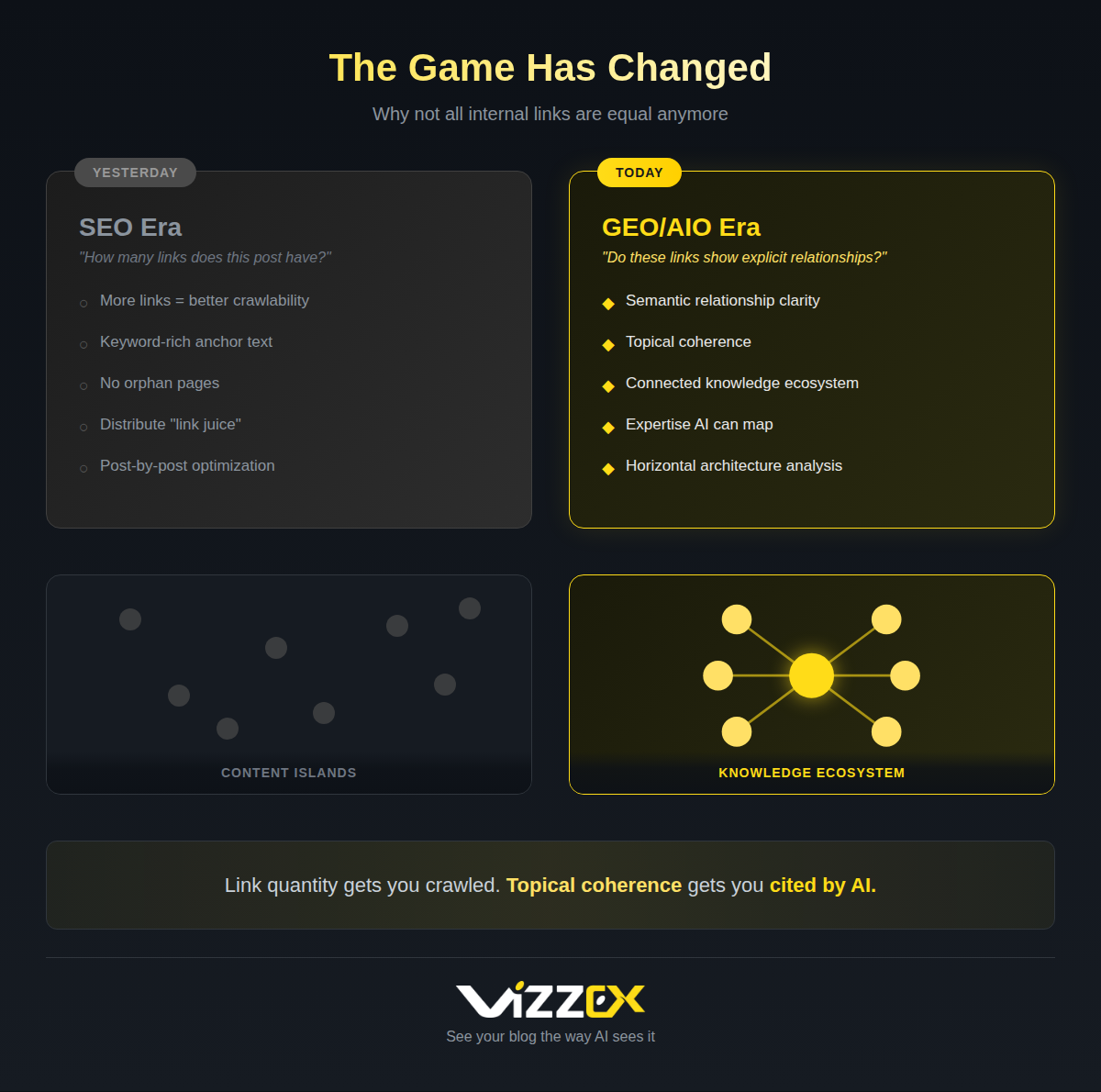
Internal linking used to be about SEO. Add more links. Use keyword-rich anchor text. Help Google crawl your site. Distribute “link juice” to important pages.
The tools built for that era—Link Whisper included—are good at that job. They help you add more internal links, faster, with better anchor text variation.
But here’s what most people haven’t caught up to yet: the game has changed.
AI systems don’t evaluate your content the way Google’s traditional algorithm did. They’re not counting links or matching keywords. They’re trying to understand whether you have comprehensive, connected expertise on a topic.
This is the shift from SEO to GEO/AIO/AEO—whatever acronym you prefer. And at the heart of it is a concept most content marketers haven’t fully grasped yet: . Understanding this shift is essential before evaluating any tool claiming to help with “AI optimization.”
From Link Quantity to Topical Coherence
Traditional internal linking asks: How many links does this post have?
Semantic relationship clarity asks: Do these links demonstrate explicit relationships between concepts?
That’s not the same question.
Why 200 Linked Posts Can Still Be Invisible to AI
You can have 200 blog posts, all internally linked, and still be invisible to AI. Why? Because those links might connect posts that share keywords without showing how the ideas actually relate. AI sees the links but can’t map the expertise. It looks like scattered topics, not connected knowledge.
What AI needs isn’t link quantity—it’s topical coherence. Explicit relationships that show how your ideas build on each other, integrate with each other, and demonstrate depth rather than just coverage.
What Link Whisper Does (And What It Was Built For)
Link Whisper is a good tool for what it was built to do: help you add internal links faster.
As you write a post in WordPress, it suggests other posts you could link to based on keyword and semantic matching. It finds orphan pages (posts with no internal links pointing to them). It lets you set up auto-linking rules so specific keywords automatically become links across your site.
Their AI-powered suggestions scan your content and score how related different posts are to each other. You can filter by relevance score, get anchor text suggestions, and implement links with a few clicks. For WordPress users who want to add more internal links without the manual hunt-and-peck through old posts, it’s genuinely useful.
If your problem is “I don’t have enough internal links and adding them manually takes forever,” Link Whisper solves that problem.
Where Link Whisper Falls Short for AI Optimization
But Link Whisper was built for the SEO era. It optimizes for link quantity and keyword relevance. It works post-by-post—you’re editing a post, it suggests links for that post. Each decision happens in isolation.
What it can’t show you:
- Whether your content architecture demonstrates topical coherence or just topic coverage
- Which posts should be your hub content (it relies on other SEO plugins to flag “cornerstone” content—it doesn’t identify hubs on its own)
- Where your topic clusters are semantically disconnected from each other
- Which posts are isolated even if they have links
- What explicit relationships are missing between your concepts
Link Whisper helps you add links. It doesn’t help you understand whether those links create the semantic clarity that AI is looking for.
What VizzEx Shows You
VizzEx was built for the GEO era. It starts from a completely different question: What does my content architecture actually look like, and where are the semantic gaps?
Instead of analyzing posts one at a time, VizzEx performs across your entire blog. This is the critical difference—rather than asking “what can I link from this post,” it maps your topic clusters, identifies which posts are genuinely connected versus just linked, and shows you the semantic architecture of your expertise.
The difference becomes obvious when you see the output.
VizzEx gives you a Content Health Summary that shows your Connectivity Tier Distribution at a glance—how many posts are Content Hubs, Well Connected, Emerging Connections, or Isolated. Not just “does this post have links” but “is this post actually integrated into your knowledge ecosystem.”
VizzEx shows your content architecture at a glance: how many posts are truly connected vs. isolated, and which actions will have the highest impact.
Semantic Relationship Types: Why VizzEx Explains the ‘Why’ Behind Every Link
When it recommends a link, it doesn’t just say “these posts are related.” It identifies the type of and explains why this specific connection matters:
“This placement is optimal for the prerequisite_foundation relationship because paragraph 15 discusses the critical need for strategic AI marketing foundation, making it the perfect context to link to content that explores whether AI will help or hurt marketing strategy.”

VizzEx doesn’t just suggest links—it explains why this specific connection matters, shows you exactly where to place it, and gives you copy-paste ready text.
That’s not “these posts share keywords.” That’s an explicit semantic relationship—the kind AI can actually map and understand.
Then VizzEx shows you the exact paragraph, the recommended replacement text with the link already embedded, and a button to copy the HTML and go directly to your editor. Strategic reasoning plus tactical implementation. To understand the full mechanics behind this process, see how VizzEx builds semantic relationship links and why that distinction matters for AI visibility.
VizzEx vs. Link Whisper: Task Efficiency vs. Topical Coherence
Link Whisper asks: “What posts contain similar keywords I can link to from this sentence?”
VizzEx asks: “How does my entire body of content connect, and where are the semantic gaps making me invisible to AI?”
One tool optimizes the task of adding links. The other shows you whether your content architecture actually demonstrates topical coherence—the connected expertise that AI systems are looking for.
This is why the comparison isn’t really about features. It’s about which era of content optimization you’re solving for. If you haven’t fully mapped out the SEO and GEO convergence implications for your content strategy, that’s the right place to start.
SEO-era thinking: More links, better anchor text, no orphan pages, good crawlability.
GEO-era thinking: Explicit semantic relationships, topical coherence, connected knowledge that AI can map as comprehensive expertise.
SEO-Era vs. GEO-Era Content Optimization: Two Different Games
Both matter. But if you only optimize for the first and ignore the second, you’re playing last year’s game.
Beyond Link Recommendations: How VizzEx Builds Full Topical Coherence
VizzEx isn’t just a linking tool. Because topical coherence requires more than links.
It identifies which posts need attention—flagging content that should be updated, rewritten, repositioned, or retired, with specific reasoning for each. When you have 50, 100, or 200+ posts, you lose track of what needs work. VizzEx surfaces it.

VizzEx identifies which posts need attention and why—whether they need updating, rewriting, repositioning, or retiring.
Content Gap Analysis: Finding What’s Missing From Your Topic Clusters
It shows content gaps in your topic clusters. Not generic “you should write about X” suggestions, but analysis of what’s working in your top-performing posts and guidance on how to replicate that success. What patterns do your best posts share? What tone works? What structure? VizzEx tells you, based on your own content.
VizzEx identifies gaps in your topic clusters and shows you why your top posts work—so you can replicate that success.
These features exist because building topical coherence isn’t just about adding the right links. It’s about having the right content, organized the right way, with explicit relationships that demonstrate depth of expertise.
Which One Should You Buy?
If you’re optimizing for traditional SEO—more links, better crawlability, keyword-rich anchor text—Link Whisper will help you do that faster.
If you’re optimizing for AI discoverability—semantic relationship clarity, topical coherence, content architecture that AI can actually map as expertise—VizzEx shows you what’s missing and how to fix it.
But here’s the real question: Which game are you playing?
The Shift From SEO to GEO Is Already Here — Are Your Tools Keeping Up?
Because the shift from SEO to GEO isn’t coming. It’s here. And the tools built for link quantity won’t help you build semantic clarity.
Link Whisper helps you do a task more efficiently. VizzEx helps you understand whether you’re doing the right task in the first place.
That’s not a feature comparison. That’s a fundamental shift in what “content optimization” even means.