

Why topical coherence and semantic clarity are now the foundation for both search and AI visibility
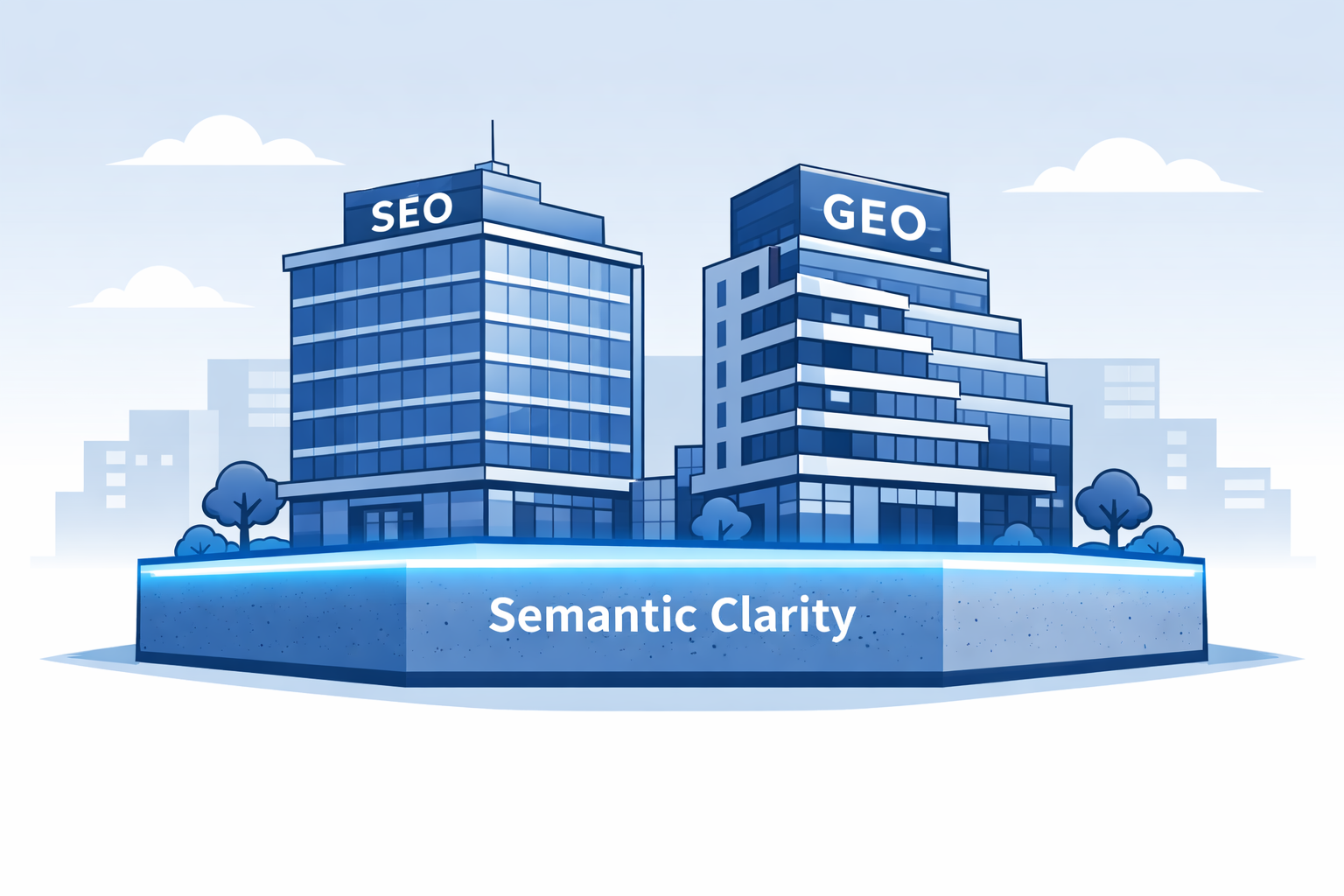
Here’s what most people miss: SEO and GEO aren’t different games. They’re the same game now.
Both are AI-driven. And AI evaluates your content completely differently than the old system did.
Google’s Helpful Content Update? It’s an AI classifier evaluating your site-wide topical coherence. ChatGPT and Perplexity deciding what to cite? AI evaluating whether your content demonstrates integrated expertise worth referencing.
Same underlying logic. Same foundation required.
And if you’re still approaching your content strategy the old way — optimizing pages individually, chasing keywords, building backlinks — you’re playing a game mired in the past, not positioned for the future. The shift requires building expertise architecture for AI search — the foundational layer that both Google and generative AI actually evaluate.
The SEO vs GEO Debate Misses the Point: Why They’re the Same Game
The SEO vs. GEO debate misses the point entirely.
People ask: “Should I optimize for Google or for AI search?” As if they’re separate problems requiring separate strategies.
They’re not. The foundation is identical.
What AI Evaluates: The Three Criteria for Content Authority
- Does your content demonstrate comprehensive expertise on connected topics?
- Can AI see how your ideas relate to each other?
- Does your body of work show integrated knowledge or scattered coverage?
The Knowledge Ecosystem vs. Individual Pages: A New Competitive Landscape
Here’s the catch: AI will evaluate your content as a connected system if you’ve done the work to make those connections explicit.
If you haven’t? AI only sees individual pages in isolation. And isolated pages compete against sources that have built the explicit foundation — semantically rich relationships across their content that demonstrate depth and coherence.
You’re not competing page vs. page anymore. You’re competing knowledge ecosystem vs. knowledge ecosystem.
And if you don’t have one, you’re bringing a page to an ecosystem fight.
There are a lot of claims about tactics that game one aspect or another of getting cited by AI. Just keep in mind: today’s hack is tomorrow’s penalty. If you chase those shortcuts without creating the foundation and structure for success, you’ll be left wondering what happened while the AI-driven world passes you by.
The Two Foundational Concepts Driving AI Content Evaluation
Topical Coherence:
Does your content demonstrate integrated expertise across connected topics? Not just “we wrote about this topic” but “we have comprehensive, organized knowledge in this space.”
Semantic Clarity: Making Your Expertise Visible to AI:
Are the relationships between your ideas explicit and visible to AI? This is how you make coherence discoverable. Understanding semantic content analysis provides the foundation for creating these explicit connections that AI can recognize and evaluate. Without it, you might have deep expertise — but AI can’t see it. Or worse, AI misinterprets it, categorizing your expertise differently than you intended because you didn’t make the connections clear.
Topical coherence is what you have. Semantic clarity is how AI sees it.
Most content fails not because it lacks quality, but because it exists as isolated islands. Great posts that never explicitly connect to each other. Topics covered but relationships unstated. Expertise that’s real but invisible.
The result: AI either skips you entirely (finding sources with clearer authority signals) or misreads what you’re actually expert in.
For a deeper framework on making your methodology visible so classification reflects your intent, see [From Guesswork to Architecture: How to Take Control of Your Google Classification].
Google’s Helpful Content System: Research Proves the System-Wide Approach
If this sounds theoretical, it’s not. Google’s Helpful Content System is already evaluating content this way. And the research proves it.
The 400-Page Case Study: When Individual Optimization Isn’t Enough
In April 2024, forensic SEO specialist Carolyn Holzman published research on Google’s Helpful Content System that included a striking case study.
An indoor hobby site with 400 pages lost approximately 70% of its traffic. The owners brought in experts and did everything right — systematically improving pages, updating content, strengthening expertise signals, fixing technical issues.
Key Findings: System-Wide Recovery Timeline
Here’s what happened:
They had to complete significant improvements across ALL 400 pages before any improvement could be seen.
Pages fixed in November didn’t recover until February — three months later.
Even new pages launched in January didn’t perform until February, after the majority of site updates were complete. The new content wasn’t penalized. It wasn’t low quality. It simply couldn’t perform until the system as a whole was addressed.
The kicker: When the team tracked individual page performance, all top-performing pages showed recovery on the same dates — regardless of when the work on each page was completed.
A page fixed in November and a page fixed in January both recovered in February.
The system-wide coherence was the gate. Individual page optimization wasn’t enough to open it.
For the full breakdown of why page-by-page optimization fails and what the recovery timeline really looks like, see [Why Fixing Your Content One Page at a Time Stopped Working].
Why Page-by-Page Content Optimization No Longer Works
The Old Content Optimization Playbook
For years, content optimization followed a predictable pattern:
- Identify problem pages
- Fix those pages one at a time
- See improvement within 24-48 hours
- Move to the next problem page
- Repeat until recovered
This made sense when search engines evaluated pages individually. Fix the page, it gets re-evaluated, rankings improve. Simple cause and effect.
That playbook misses what actually moves the needle now.
Not because the tactics are wrong. But because the evaluation system changed.
How the Evaluation System Changed Everything
The researcher put it directly: “Google doesn’t only index, rank, and serve individual pages on a site. The Helpful Content System polices a site-wide factor based on the topical nucleus of a site.”
Old model: Each page evaluated independently. Fix a page, that page improves.
New model: Your site evaluated as a system. Individual pages can’t outperform a site-wide classification. The system has to work before individual page optimization pays off.
This has implications across everything in SEO:
- Recovery: You can’t fix a traffic drop by optimizing pages one at a time
- Rankings: Individual page optimization hits a ceiling set by your site-wide coherence
- New content: Fresh posts can’t outperform a weak system architecture
- AI citations: ChatGPT and Perplexity apply the same logic — they cite sources that demonstrate comprehensive expertise, not isolated posts
When rankings and traffic drop, the teams still optimizing page by page are wondering why things don’t react as quickly as they used to.
The pages may need improvement — but without system-level coherence, page-level optimization hits a ceiling.
Building Topical Coherence: The System-Wide Approach That Works
If page-by-page optimization isn’t enough, what does building topical coherence with semantic clarity actually require?
1. Gain System-Wide Content Visibility Beyond Page-Level Tools
You can’t fix what you can’t see. And page-by-page tools literally cannot show you site-wide topical coherence.
The researcher noted this gap directly: “There is no software tool that can take HC measurements because at this time on-page tools measure only one page at a time.”
You need to see your content as a connected system — which topic clusters exist, how they relate to each other, where coherence breaks down, and where semantic clarity is missing.
2. Topic Cluster Health: Core vs. Tangential Content
Not all content contributes equally to your topical authority. Some posts strengthen your core expertise. Others dilute it.
The HCU research included a pet site case study where core topics maintained performance after an update while tangential topics collapsed. Content about food, beds, and toys reinforced the core positioning. Content about insurance and silencers (unrelated to the core expertise) was judged unhelpful.
This wasn’t about individual page quality. The difference was how well each topic cluster fit within the site’s established expertise.
3. Building Explicit Semantic Connections Between Content
This is where most content fails the AI test.
You might have 50 posts about marketing automation. If they exist as isolated islands — each covering a topic without explicitly connecting to the others — AI sees fragmented coverage, not comprehensive expertise.
Semantic clarity means building the explicit bridges that demonstrate how your knowledge connects:
- How does this concept relate to that one?
- What’s the prerequisite understanding?
- Where does this fit in your methodology?
- How do these ideas build on each other?
Not just internal links. Explicit relationship language that shows AI your thinking is integrated, not scattered.
Understanding Google’s Recovery Timeline: What to Expect
Google’s own documentation sets realistic expectations: “Sites identified by this system may find the signal applied to them over a period of months.”
The 400-page case study showed a three-month gap between completing work and seeing recovery.
This has profound implications:
Every day you spend optimizing the wrong thing is a day added to your timeline.
If you spend three months optimizing individual pages when the problem is site-wide coherence, you haven’t made progress — you’ve lost three months.
Understanding what to fix matters more than how fast you fix it.
VizzEx: A Tool Built for System-Wide Content Analysis
I built VizzEx by studying how AI actually evaluates content — through semantic relationships and explicit connections between concepts.
It analyzes content horizontally across your entire blog, not vertically one page at a time, because that’s how AI evaluates expertise.
What’s striking is that I found the HCU research after VizzEx was already built. The research validates exactly what we designed for: system-wide coherence and semantic clarity are what matter — whether you’re trying to get cited by AI or pass Google’s classifier.
VizzEx shows you:
- Topic clusters and their relative strength — See which areas you’ve built authority in and which are too thin
- Content islands — Identify clusters that should connect but don’t
- Connectivity scores — Understand which posts are integrated into your knowledge ecosystem versus isolated
- Specific bridge recommendations — Get actionable guidance on which semantic connections to build, with reasoning for why each matters
The goal isn’t just to see the problem. It’s to see what to do about it — in priority order, with specific implementation steps.
Because understanding that you need topical coherence and semantic clarity is only useful if you can actually see your system and know where to start.
Ready to See Your Content the Way AI Sees It?
If you have a blog in WordPress or HubSpot and want to take VizzEx for a spin, we’re running a beta program right now.
You’ll get a full analysis of your blog’s semantic structure — the topic clusters, the connections (or lack thereof), and specific recommendations for what to fix first.
Stop bringing pages to an ecosystem fight. See the system.
Continue Reading
Related articles:
- From Guesswork to Architecture: How to Take Control of Your Google Classification — The shift from hoping Google classifies you correctly to making your methodology visible
- [Why Fixing Your Content One Page at a Time Stopped Working] — The mechanics behind why the old recovery playbook fails and what the timeline really looks like
This article draws on Carolyn Holzman’s independent research on Google’s Helpful Content System. For the full technical breakdown with all the case study details, read the complete analysis.
What’s your experience? Are you still optimizing content page by page? Have you started thinking about your content as a connected system? I’d love to hear what’s working (or not working) for you.